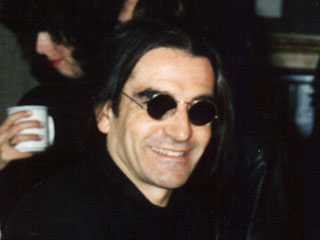
So let me introduce to you, the one and only David Peel. Wondering why I just quoted “Sgt. Pepper’s Lonely Hearts Club Band?” You will find out in due time (even though the reference doesn’t link up perfectly because McCartney wrote these lyrics even though the lyric is credited to the Lennon/McCartney songwriting duo). I’m being pedantic. Let’s move on to the first post in the new category Obscure Classic Rock.
I want to first share with you all how I heard about David Peel. Don’t worry, this is not a long, fireplace story. Actually, my father told me about David Peel last night. This is one thing I love about 60s/70s music. At times, the list of acts seems endless. It’s not, obviously. There is a fixed number. But I have done a good amount of research on 60s/70s music over the past 4-5 years (starting when I was a senior in High School), and, I’m still learning about influential acts that I had never come across previously. And that is awesome.
My dad recalled how he used to go down to Greenwich village in New York City with his buddies back in his teens (early 70s) and he would often see David Peel (born David Rosario) performing with the Lower East Side Band (apt name). Peel would sit down and talk with my dad and his friends occasionally. My dad remembers him as a nice, intelligent guy, who sang songs about marijuana and revolution. Revolution, specifically the recent Wall Street Occupation, is why Peel was brought up in conversation.
David Peel and the Lower East Side Band. Ever hear of them? No? Well did you know that they are often cited as early progenitors of punk rock? Also, did you know that Peel became incredible friends with John Lennon and Yoko Ono (there is your answer for the opening segment)? Lennon had good taste. Well, so did Peel!
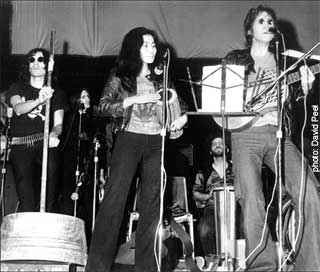
David Peel (left) performing with Yoko Ono and John Lennon. Don't Lennon and Peel sort of look alike? More on this later
John Lennon once compared Peel to Pablo Picasso. A bold proclamation, indeed. Well, similar to Picasso co-founding the Cubist movement, Peel definitely had a hand in providing some inspiration to the emerging genre of punk.
Peel and the Lower East Side band first recorded music in the late 1960s. They created a blend of “street rock” that targeted topics like marijuana and the police. It was fresh and attractive to the counterculture movement. Songs like “I Like Marijuana” and “Oink Oink” were obviously scorned by authority, but enjoyed by the youthful population that gathered in Greenwich Village. Peel and the Lower East Side band was actually among the first bands to regularly perform on cable TV in Manhattan. He appeared on the public-access cable TV channel of Manhattan Cable Television. He also performed at the first Smoke-in concerts at Central Park.
It was in front of a crowd at Washington Square Park in 1971 when Lennon first saw Peel. He was quoted saying, “He was shouting: why do you have to pay to see stars? I was embarrassed. I thought surely he must know we are here. Yoko and I love his hair, snazzy tight trousers and Hai Karate aftershave.” They quickly became friends and Lennon signed Peel to Apple Records where he promptly released The Pope Smokes Dope in 1972. The record was banned in nearly every country in the world, except for the US, Japan and Canada. I don’t believe this record was playing in cafes outside the Vatican. The fervor that Peel engendered is funny. It’s very…punk! And the music backs that statement up.
I mean listen to this. “Oink, Oink” was recorded in 1968. It is like Beach Boys meets the Ramones. And this was recorded when Dee Dee Ramone was 17 years old. Punk music is rooted in US garage rock and the New York underground (bands like the Velvet Underground). Peel, like Lou Reed, sang about drugs and unsavory NYC practices. In 1969 Protopunk was founded by MC5 and the Stooges (Michigan-based bands), but I do believe that Peel was a true predecessor of the burgeoning movement and, unfortunately, he does not get the credit he does deserve.
Peel and Lennon stayed close friends, Peel adopting Lennon’s thick-glasses style, and Lennon sampling Peel’s leather coat look (similar to retro Cavern Club Beatles). The two looked so much alike that Bob Dylan actually called a picture of Peel, John Lennon, and, because everyone takes what Bob Dylan says as the truth it seems, the FBI was also fooled. A picture of Peel was in Lennon’s FBI file. Lennon did help Peel become well known and he has performed with musicians like B.B. King, ELP and Alice Cooper. Peel still records music today and his full discography can be acquired. I suggest checking him out more. He is a punk visionary. And he recorded an album entitled The Pope Smokes Dope. I mean, come on.

 The Music Court