Archive by Author

The Bands of Summer – High Highs

12 Jul

High Highs

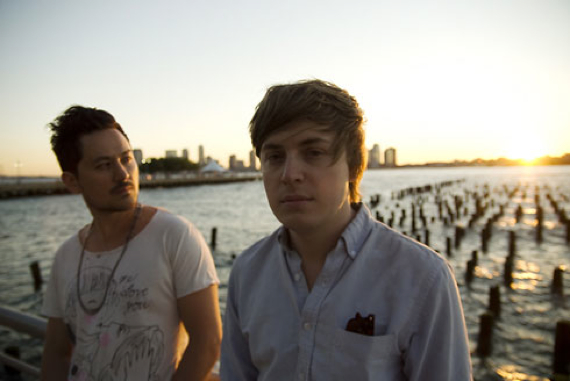
Today marks day two of the Bands of Summer new music special section. The order of these posts has no meaning, by the way. I am not attempting to rank the bands, but instead introduce their music to a wider audience. We travel today to ambient indie/pop after our exploration of the upper register of indie/folk with Dry The River yesterday. Everyone say hello to the Australian-born act titled High Highs.

High Highs is currently based out of Brooklyn, but their roots are firmly planted in a Sydney studio where singer/songwriter Jack Milas and electric/pop produce Oli Chang met. High Highs benefited from good fortune. While the two musicians did combine forces in Australia, it was only for a limited time, and, if not for the fact that they both worked for the same company and got offers to move to New York, the band would probably not be garnering record label attention today. The band attracted drummer Zach Lipkins and the tres amigos are currently recording, releasing and touring. But they are still a ways off from an album.

“We’ve only put out two songs, and that’s the story of it so far,” said Milas in an interview with Spinner back in March. Since then the catalog has expanded to four songs (one cover) according to the band’s Bandcamp. Two of these songs are available for free downloads. As for the band’s sound:

“Our PR agent, she wanted to insist that our genre of music is “church wave,” said Milas. “I find the whole “wave” thing really funny, in a good way. It works. It’s not music that’s religious in any way. It would just sound good in a church. Maybe we’re on to something.”

Church wave. I guess it’s a new way to describe the ambient indie/pop trend that is spreading quickly through the music world. With Milas’ falsetto and Chang’s ethereal music taste, High Highs is a solid EP/LP away from shooting up the ranks of the genre.

We start with “Horses,” a tasteful and intelligent release that floats with effervescent flare. The song, released in March, opens with an acoustic riff that merges into a spacey pre-verse segment. Milas’ voice is relaxing, imperturbable even. You get the sense that he is a real-life zen master. The song lulls listeners into a state of relaxation, but keeps them up with the poppy perambulating rhythm.

“Open Season” was released in November of 2010 and it was the piece that placed High Highs on the radar. The 3:48 song is a slice of indie pop mastery. The chugging rhythm moves well with Milas’ verses which evoke images of traveling down the California coast watching waves tirelessly crash into the sandy shore. You can almost feel the salty wind on your face. The song’s catch though resides at the minute mark. The well-placed keys make you want to whistle the segment that sticks to your ears like wet sand. The end provides this neat call and response ending with the acoustic riff under the first verse beautifully sung by Milas.

High Highs is a band worth looking out for. Hopefully their album will drop this year or early next year. For now, continue viewing their Myspace, Facebook and Bandcamp

The Bands of Summer – Dry The River

11 Jul

Over the next week The Music Court will profile six new bands that you, if you are not already, should be listening to. “The Bands of Summer” is the title of this special summer section. Many listeners who prefer oldies often conclude that no music released today is worth listening to. This is a false sentiment, and I know because I was once a recent music iconoclast. This list is short and there are several more talented new bands that are worth mentioning. Do a quick google search for best new bands of 2011 and you will be prompted with a dazzling display of new acts to listen to. Music is alive and well, trust me.

Let me explain that last sentence with a bit of a disclaimer. When I say music is alive and well, I am not talking about dub-step/hip-hop (throw-away genres that do not fit into this post). If you want to rage, that is the music for you, but if you are into appreciating tunes then this is the correct place. Many solid releases today fit under the broad umbrella of “indie” music. I believe you can split this genre up into several sub-genres (kind of like what I did with psychedelic music). There is folk/indie that has exploded with bands like Fleet Foxes and Mumford and Sons (who are leading the new British folk revival that parallels the early 70s). Then there is indie/pop which combines large bands with ambient sounds (like Arcade Fire and Edward Sharpe and the Magnetic Zeros). There are other sub-categories, but, for now let’s leave it at that. The bands that I will profile fit neatly into the parameters of indie music.

The band today is a up-and-coming indie/folk act who take the Mumford and Sons sound and transform it into music that is slightly less predictable and even operatic at parts. Dry The River is about to blow up and see the success that Mumford and Sons gained with Sigh No More. Singles are being released and music lovers are on their heels waiting for a full-length LP. Plus, on their Facebook “artists we like” section, The Magic Numbers are mentioned and that is just awesome.

Dry the River is best known through their tours. They have been touring since they were founded by Norwegian singer-songwriter Peter Liddle. Liddle added homeless punk-rock drummer (yes, he was homeless) Jon Warren, classically-trained violinist Will Harvey, guitarist Matt Taylor and bassist Scott Miller. The east-London band self-released a five-song EP in 2010 and have released a few singles since then (including the one below). What I think is most astounding about the band is their maturity. It sometimes takes an album (or two or three) before a band can release something worthwhile. But the EP is stuffed with rich sounds and Liddle’s powerful voice and the song below, “New Ceremony” can shoot up the charts with correct marketing. There is a huge record label bidding war for Dry the River and I understand why. It does not take a genius to realize that indie/folk is in and Dry The River is demonstrating their mastery of the genre.

“New Ceremony” is a perfect song. I do not often give such credit to bands, but Dry The River deserves it for this hit. The opening acoustic riff is intriguing. It is not effervescent, but rather somewhat melancholic. Liddle’s voice is choir-like. It explores the upper register with accuracy and efficiency. His annunciation flows well with the riff. The harmony leads into a true folk drop. The violin picks up the rhythm section with the drums. As the song starts adding more elements it speeds up and you get the feeling that it is about to get loud, and, true to Indie form, it does. But it is more theatrical than Mumford and Sons who simply speed up their acoustic instrumentation. Dry the River’s chorus (well the first part) takes a page out of Arcade Fire’s book. The music collides into an organized catharsis and Liddle’s voice is PERFECT. Seriously, it fits so well into the song’s somber explosion. Then the chorus shifts into a call and response harmony that fades into a violin rendition of the riff that transforms back into the chorus. It hits and hits and hits. The song is like Dry the River’s grand entrance into the indie party. Do you hear why record labels want to sign them?

I predict that after Dry the River releases an official LP they will become the new “in” Indie band. You will begin to hear “New Ceremony,” which has under 15,000 views on Youtube, on radio stations everywhere. So get linked in with Dry the River and enjoy the ride of witnessing the rise of a talented act.

Fourth of July Trivia Answers

8 Jul

YEAH!!! America! - Wait, What?

Hopefully you all enjoyed your Fourth of July weekend. Now that we are all back to being fully ensconced in the drudgery of life without reckless barbecues and fireworks play, I think it is a good time to reveal the answers to the Fourth of July Music Trivia Game. If you still want to play, go and answer these questions prior to reading this post Unfortunately, I cannot crown a winner this week because no one commented on the post with their name and answers. Perhaps I will create a better way to crown the winners in the future without making individuals comment on the post. I can still post up the answers and tell you all how you did. Let me commend everyone who played for all getting the first question correct. The national anthem did indeed come from a British Drinking Song (the one below to be exact).

Credit to the Georgia Tech Glee Club for the rendition. While there was a 100 percent success rate on the first question, things did not go as well for the other three questions. Let’s answer them one by one.

2.) I want to know what American musician gave Randy California his stage name?

The popular choice was Jim Morrison. It does make sense in both the geographical and time aspects. California received his nickname in 1966 and the Doors formed in 1965. But despite the links, Morrison did not give Randy his nickname. Jimi Hendrix, who met Randy at a guitar store in NYC, gave him the nickname of California when he joined Hendrix’s short-lived 1966 band, The Blue Flames. The band, which also featured bassist Randy Palmer, had a slight same-name problem that Hendrix solved by giving each Randy a nickname based by where they came from. Palmer became Randy Texas and Randy Wolfe became Randy California. Congrats to those who got this question correct

3.) Jimmy Page is often cited as the originator of using a violin bow on a guitar, but this is incorrect information. Who was the true FIRST guitarist to popularize this practice?

I admit, this was a bit of a trick question. But I’m glad I asked it, because it just exposes the unfortunate anonymity of the guitarist who started this inventive trend and also still serves as a great guitarist. Eddie Phillips did not receive a single vote, but he is the correct answer. Jimmy Page was inspired to strike the guitar with a violin bow by David Lindley, a multi-instrumentalist who did indeed experiment with this practice, but did so after Eddie Phillips started. There is the slight catch. Phillips first played the guitar with a violin bow in his pre-Creation band The Mark Four. With the Creation, Phillips mastered the playing style and used it in several popular recordings.

4.) Newman vocalist/keyboardist John “Speedy” Keen worked as a chauffeur for a famous British band who’s guitarist thanked Keen by creating the band around him to showcase his work. What was that band?

Most votes went to the Rolling Stones, but “Speedy” Keen was not driving around Mick and Keith. Instead, Keen chauffeured Pete, Roger, John and a probably intoxicated Keith Moon. Townshend, a good ear for talent, gave Keen the opportunity and man did they strike gold with “Something in the Air.” Enjoy!

New Coldplay Single – “Moving to Mars”

7 Jul

When you mention Coldplay you often get an eye-roll or a noticeable disapproving grunt. I know I have mentioned this phenomenon before on the blog and, while it seems that I always preface a Coldplay-related post with a disclaimer, I am generally bemused by Coldplay’s treatment. Yes, I do understand, that they are laughing all the way to the bank, and perhaps their mainstream economically succesful status may be a drawback for some, but Coldplay definitely odes not deserve the rap it gets. Their new single “Moving to Mars,” which appears on a three-song EP foreshadowing their new studio album’s Fall release, demonstrates the continuing maturation of this piano pop/rock juggernaut.

Chris Martin has an excellent voice with broad range. “Moving to Mars” is a soft piano piece that represents sincere simplicity and portrays Martin’s range. The melody is ingenuous and not at all gaudy (a label that some of Coldplay’s songs receive). The song is inventive and this is much appreciated. It’s keyboard driven filler portions alludes to some prog-rock conventions of the 1970s. Also, for a plus-four minute song, it moves quickly. Well done.

John McVie – From the Bluesbreakers to The Chain

5 Jul

John McVie? Isn’t he the bassist from Fleetwood Mac? Absolutely. But he wasn’t always in Fleetwood Mac. Welcome John McVie into this week’s installment of “Same Artist, Different Place.”

McVie got his start by playing in High School with a cover band. This has become an almost hackneyed opening to all musician stories, but High School cover bands are truly the way that most famous musicians get started. So the lesson here is to seek out the talented musicians in your High School (like McVie) and latch on to their band. Can’t play an instrument? No matter, be their manager or something. Let’s get back to reality.

McVie played music from the Shadows with his band Krewsaders until leaving school at 17 for tax inspector training. Music, at that time, became a side hobby until bassist Cliff Barton turned down a part in a new Chicago-blues style band called John Mayall and the Bluesbreakers and suggested that Mayall give McVie an audition. Mayall listened and was impressed with McVie. So, Mcvie, with no formal training in music, was accepted into the Bluesbreakers. Mayall gave him albums from B.B. King and other blues musicians to study.

Before Fleetwood Mac, there was the Bluesbreakers, who would later become known as a talented platform band, where English musicians went before becoming famous with other acts (kind of like The Yardbirds). Musicians like Eric Clapton, Jack Bruce, Mick Taylor, “Sugarcane” Harris, Andy Fraser and Aynsley Dunbar played with the band. The band was exceptionally talented and it sustained itself with tremendously talented musicians.

After Clapton and Bruce left the Bluesbreakers (they would later form Cream), Mayall added guitarist Peter Green in 1966 and soon after added drummer Mick Fleetwood. I bet you see where this is going. McVie developed a great relationship with Green and Fleetwood and after Green was replaced by Mick Taylor he started a new band which he called Fleetwood Mac, after his beloved rhythm section of Fleetwood and McVie. It didn’t take too much convincing to get Fleetwood over to the new band and after McVie became dissatisfied with Bluesbreaker’s move towards Jazz he joined the new band in 1967.

The rest is history.

Here is McVie playing “All Your Love” with the Bluesbreakers (Eric Clapton on guitar).