Archive | Obscure Classic Rock RSS feed for this section

Digging Deep – The Roots of Punk/Psychedelia

1 Nov

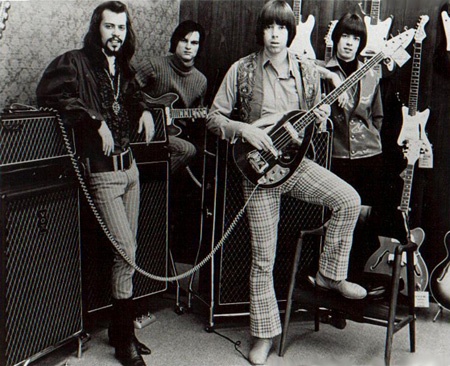
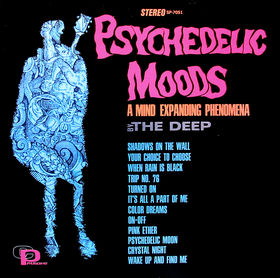
Are you in a psychedelic mood? Well, if not, let me get you in one. The Deep is a perfect example of an obscure classic rock band, one that has been often overlooked by fans of the protopunk and psychedelic genres of music. The band achieved virtually no success (unlike their Cameo-Parkway label mates Question Mark and the Mysterians who scored big with their 1966 hit “96 Tears”) and are rarely mentioned in today’s discussions about inspirational 60s bands. The Deep is categorically underrated and this is unfair. They only released one album (under the name The Deep) and it is quite possible that The Deep were more of a studio band; they did not tour to support their only release Psychedelic Moods. But that one album should have provided the band with a little more popularity.

The Deep was formed in Philadelphia during the mid-60s. Greenwich Village folk musician Rusty Evans (Marcus Uzilevsky) took on the role of lead guitarist and singer-songwriter. Past him, the identity of the rest of the band members is shrouded in a bit of mystery. We have names, but nothing is confirmed. Actually, folk musician David Bromberg is thought to have played on the debut release, but the tracks which he played on are unknown.

Psychedelic Moods does have one claim to fame. It was released in October of 1966. *Disclaimer* – this next comment is subject to an ongoing debate. The Blues Magoos’ Psychedelic Lollipop was released on November 1 of 1966 and The Psychedelic Sounds of the 13th Floor Elevators by the 13th Floor Elevators was released later in November. The Deep is thought to be the first band to employ the word psychedelic on an album name. Neat, right? It may or may not be true. Who knows? But it seems plausible. That is not why I think they should have received more attention. Why should they have? Their distinct blend of protopunk and psychedelic music was fuzzy, warm, infectious, and ahead of its time. That’s why.

“Color Dreams” is a great example of an experimental band. You can tell that they are mixing a concoction of psychedelic and garage rock/protopunk. It is tasty. The song’s base is a normal riff and vocal. Layered on this foundation, like moussakka, is a soft portion of strange noises, light piano, and muddled voices. In 1966, this psychedelic experimentation was fresh and exciting. The Deep was one of the first bands to capture this sound.

“Trip #76” is a repetitive piece that plays with a basic, somewhat shrill guitar riff. It reminds me a lot of music that the psychedelic band Love produced around the same time. Drawn-out poetry, repetitive riffs; garage psychedelia at its finest and earliest!
The Birds Who Knew How to Spell – The Birds’ Story

26 Oct

If there are two things I’d like for you, my faithful and always wonderful reader, to get from this Obscure Classic Rock post (besides the fact that I must come off as an obsequious music writer – I do have unpopular sentiments, trust me), it is that a band name is exceptionally important and that bands that famous classic rock musicians played in prior to the pinnacle of their success often go understated. We will get to the name part a little later. For now, I want to provide some commentary on the latter point.

Before talented artists hit it big in popular bands, they almost always start in another band. The band may contain members of the ultimately successful line-up, but, it is exceptionally rare that every member of the known line-up grew up and formed the band together. Now, usually the first band is fallow, raw, and, therefore, understandably unsuccessful. But we are talking about the 60s and 70s, man. Even the bands before the bands were awesome. So why didn’t they just succeed at the outset?

Remember a few posts ago I mentioned how the Seeds experienced decreased popularity by mid-1968. The Seeds, a very talented band that in a lesser talented year may have been among some of the top acts, were going up against bands like, hmm, let’s see, The Doors, The Beatles, The Rolling Stones, The Mamas and the Papas, Simon and Garfunkel – need I really continue? Quite simply, the talent was incredible, and unfortunately bands frequently fell between the cracks. One such band (keeping with the semi-Fall theme) was the Birds. No, not the Byrds. The Birds.

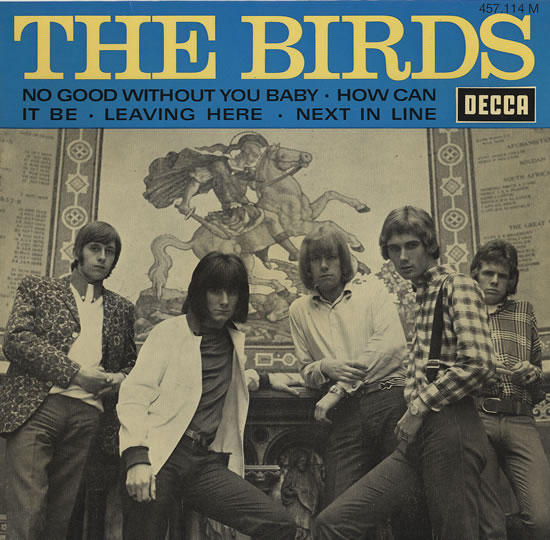
These Birds

And now we come back to the first thing I wanted you to take from this post. When you name your band, be original. Choose something that some other group (perhaps from across the pond) won’t think of. It is, though, rather impossible to anticipate same-name problems, so sometimes you must go on luck. The Birds and the Byrds were producing music at the same time, and at the height of The Birds’ British success, The Byrds’ version of “Mr. Tambourine Man” was just released (1965) by the British CBS Records. And, unfortunately for the Birds, it went to town on the UK single charts. A slight issue, right. While both bands might have spelt the avian animal’s common name differently, they pronounced the name the same, and that’s what did the Birds in.
 
The Birds are known as being Ronnie Wood’s first band. Wood later played with The Creation, Faces and, now, the Rolling Stones. Bassist Kim Gardner also got his start with the Birds, later playing in The Creation with Wood. The Birds, though, unfortunately get that “first band” title too often. They were a talented act that, in 1964, were labeled as the next big thing, receiving equal billing with the Who at some concerts.
 
The Birds were formed in 1964 when the members were teens in Yiewsley, London. In addition to Wood and Gardner, the band featured vocalist  Ali McKenzie, guitarist Tony Munroe, and drummers Bob Langham and Pete McDaniels. They originally called themselves the Thunderbirds (which was actually the name of a 60’s band from Iowa, but, one that did not achieve success equaling the Byrds, so if the Birds kept their original name, both bands would have probably been able to coexist.) They changed their names because they were to play a show on the same bill as Chris Farlowe whose backing band was named the Thunderbirds. Whole lotta’ name problems, hah?
The band earned a recording contract with Decca after a “Ready Steady Go” Battle of the Bands, and they released their first two singles “You Don’t Love Me” and “Leaving Here.” They would continue to release music (including “That’s All I Need You For” which was a never recorded track from the 1967 movie Deadly Bees)  until a lack of success led to the group, which at once held much promise, disbanding. But, like I mentioned, a lack of success did not mean that the band wasn’t good, and the Birds represent another great band that was not able to have sustainable success during what was both the best and worst time to be a musician (the mid-late 60s).
 
 
“That’s All The I Need You For” (which as you can see was only partially done for the movie. The end features Ali McKenzie’s reformed Birds line-up playing the song.) features McKenzie’s excellent R&B/Mod rock voice mixed with some quality guitar work.
 
 
“Leaving Here” is an excellent first release. Lively energy is emitted from the song in the fast-paced chord-heavy guitar track and the turned-up note-striking guitar solo. You can hear that British R&B (“maximum R&B”) much in the style of the Who, the Creation, the Smoke, and other Mod-style bands playing at the same time as the Birds. The music was dance-able, hyper and melodious (even with the fuzzy, loud guitar). And the Birds were excellent at creating it for the short time that they did play together.

Hey Joe. Exploring the Leaves

18 Oct

It is fitting that today’s Obscure Classic Rock band shares its namesake with a particular above-ground plant organ that will get a lot of attention over the upcoming weeks in New York. Fall foliage is gorgeous, until the colorful palette of leaves tumble to the ground and leave the trees barren, and the yard full of crunchy, multi-colored nuisances. Unless, of course, you enjoy the monotonous task of raking leaves. If that is so, Fall is your type of season.

Anyway, if you have not guessed, the band that I will be profiling today is The Leaves, a mid-60s garage-rock from California. Last week I profiled the Seeds, another garage-rock act from Los Angeles. From the Seeds to the Leaves to the…what other botany-based 60s band will I come up with.

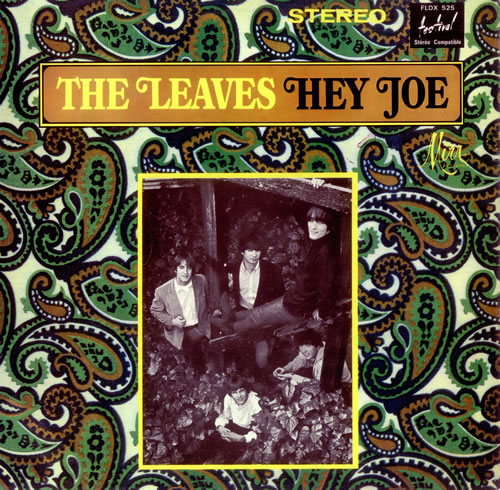
The Leaves were formed in 1963 by bassist Jim Pons while he was a student at Cal State Northridge in LA. Originally called the Rockwells, the Leaves developed their new name from a response the band heard to the typical 60s greeting “what’s happening.” The response was, “the leaves are happening” and the Leaves stuck.

Pons was joined in the band by John Beck (vocalist), Bill Rinehart (lead guitar, replaced by Bobby Arlin), Tom Ray and Robert Lee Reiner. The Leaves began playing surf/dance rock and played their first show at a school gymnasium with Captain Beefheart and His Magic Band, thereby marking another fantastic concert at a school gym performed by awesome 60s musicians. After the Byrds left their residency at Ciro’s on the Sunset Strip, which was a rock n’ roll club in the 60s, The Leaves replaced them and were there discovered by singer/actor Pat Boone who got them a record contract.

And like a bat out of hell, the band released two popular singles in 1965. “Too Many People” which I am including under this paragraph and “Hey Joe,” even though “Hey Joe” wasn’t popular until it was released a third time. I’ll explain

Before I start talking about the song above, I’d like to talk about “Hey Joe” and the rest of the history of the band. Obviously, “Hey Joe” is most recognized as a Jimi Hendrix distored, hard-rock song; one of his guitar saturated pieces that oozes with emotion and pure awesomeness. But I do feel like many do not know that the song was not initially presented in its rock n’ roll form by Hendrix. (The song does have a history which I am not going to discuss in this post – stay tuned for a future history). The first version was The Leaves’ gritty, fuzzy, stripped down, developed version.  The Leaves were a young band and “Hey Joe” was their tour de force. The song was initially released in 1965, but it was pulled back by the band because it was unsatisfactory. Then it was released again in 1966 and that recording flopped. It was not until original guitarist Bill Rinehart left and new guitarist Bobby Arlin experimented with a fuzztone, that the song became popular, a #1 hit in LA (#31 on Billboard).

The band broke up in 1967. Arlin went on to form the psychedelic band The Hook and Pons joined the Turtles. In 1970, the band reunited for a year and then broke up again. Pons also played in the Mothers of Invention before becoming a video director for the New York Jets in 1973. He retired in 2000 and moved down to Jacksonville where he now does game-day video for the Jaguars and plays stand-up bass in a bluegrass gospel band called Deep Creek.

He lived on Long Island and worked for the Jets (that is swell in my book!)

Let’s listen to the songs. “Too Many People” is clearly Beatle-inspired. It is a good example of repetitive garage rock. A constant riff, vocal melody, and a harmonica. Mix this with screaming fans and you have got yourself a mid-60s rock band. “Hey Joe” is just, well, different. The fuzzbox immediately screams a more mature form of garage rock, an improvement to the buzzing sound that became synonymous with garage rock. The song is packed with emotion, solid bass work and an  enjoyable guitar. It is the rock original and it is important to recognize it as such.

Planting the Seeds: The story of Sky Saxon and the Seeds

11 Oct

The Seeds

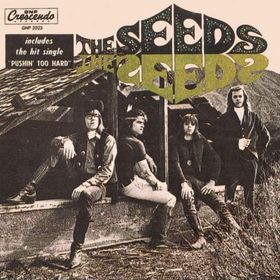
The Seeds is a band that teeters on the line between obscure and known. I’m not sure where to place them myself. While I do think it is safe to say that many have not heard of this garage rock pioneer, the band may be a little too known to be classified in this obscure category. I’m arguing pedantic semantics with myself. The reason I want to include The Seeds in this Tuesday’s “Obscure Classic Rock” is because I featured David Peel and the Lower East Side Band last week. As you may remember (and if you don’t click here to view last week’s post), I labeled Peel as an inspirational pre-Punk force. The Seeds, with their blend of angsty garage rock and bouncy beats, do fit the description of a band that planted the seeds for Punk rock. Pun very much intended. So for the second week in a row we focus on a pre-Punk performer, but this time we enter into an earlier realm of mid-60s rock n’ roll.

When you explore the premiere early roots of Punk rock bands like the Kinks, the Who, and the Small Faces are mentioned. These are bands that started developing the fast-paced, strained pop sound that Punk became known for in the 70s with the Sex Pistols and the Ramones. The Kingsmen’s version of “Louie, Louie” (1963) is aptly cited as the first proclamation of Punk. The song even sparked an ill-informed FBI investigation over the non-existent obscenities that are not in the song. When I look at the early stages of Punk music, though, I quickly look at the impact of Mick Jagger. His carefree, over-sexualized, Elvis-on-acid-inspired on-stage pelvic movements clearly inspired performers like Iggy Pop and a little-known singer named Richard Marsh, better known as Sky Saxon of The Seeds.

To some, Sky Saxon is a cheap Mick Jagger impressionist, but I think he something much more than this. Saxon formed the Seeds with keyboardist Daryl Hooper, guitarists Jan Savage and Jeremy Levine (who left the band because of personal reasons shortly after the first recording session) and drummer Rick Andridge. Sky is credited as the bassist and in one of the videos below he is playing an egg-shaped fire-red bass guitar, but he did not play bass during recording sessions. Instead, Hooper, much-like Ray Manzarek did with the Doors, played a keyboard bass.

The band released their first single “Can’t Seem to Make you Mine” in 1965 and it became a regional hit. The band, even though remaining most popular in southern California, reached the top 40 with their 1966 song “Pushin’ Too Hard.” After this release, they hit moderate success with a few other singles, but their popularity slid and by the end of the 60s the band was transformed with new members into Sly Saxon and the Seeds and then broke up in the early 70s. We are going to look at the band’s top two singles in this post. Both of these songs can be found on the Seeds’ eponymous debut album released in April of 1966. The album has aged well and it is now looked at as early Punk inspiration and proof that Punk existed before the 70s.

Simple repetitive melody, possessed vocal (Sky seems drugged), neat and concise keyboard solo. It’s pop. I’m not sure if we can hear Punk in this early release (even though Sky Saxon just looks and sounds ahead of his time.) The song is not grungy, but instead pretty organized and easy. It is like cool and collected garage rock mixed with sunny California pop. Keep this sound in mind and let’s move ahead a year.

What a change. Throaty-punky vocal. The guitar has the traditional 60’s twang. The keyboard is one of the most understated and interesting parts of the song. It fits, but it doesn’t fit. I can’t seem to place that quiet, even subtle sound. The tune, which clearly provides a great example of fuzzy and raw garage rock, has a rhythm that resembles Punk. I hear Protopunk in this release.

Sky Saxon’s future would involve joining a religious group in California called YaHoWha for many years. The band reunited in 1989 to headline “The Summer of Love” tour (which also included Arthur Lee and Love). In 2003, Saxon and Savage toured with other members, but Savage had to depart midway through the resulting tour. Saxon continued performing, recording and writing up to his passing on June 25, 2009.

If you click on Sky Saxon’s name above you will be linked to his official website. A tribute album featuring covers of Saxon’s songs by performers like Iggy Pop, The Bangles, The Chocolate Watchband, Strawberry Alarm Clock, The Electric Prunes, will be released soon (perhaps by the end of the year) so definitely keep tabs on what will most definitely be a must listen when released.

Peel the Lower East Side and Enjoy Pre-Punk Punk

4 Oct

So let me introduce to you, the one and only David Peel. Wondering why I just quoted “Sgt. Pepper’s Lonely Hearts Club Band?” You will find out in due time (even though the reference doesn’t link up perfectly because McCartney wrote these lyrics even though the lyric is credited to the Lennon/McCartney songwriting duo). I’m being pedantic. Let’s move on to the first post in the new category Obscure Classic Rock.

I want to first share with you all how I heard about David Peel. Don’t worry, this is not a long, fireplace story. Actually, my father told me about David Peel last night. This is one thing I love about 60s/70s music. At times, the list of acts seems endless. It’s not, obviously. There is a fixed number. But I have done a good amount of research on 60s/70s music over the past 4-5 years (starting when I was a senior in High School), and, I’m still learning about influential acts that I had never come across previously. And that is awesome.

My dad recalled how he used to go down to Greenwich village in New York City with his buddies back in his teens (early 70s) and he would often see David Peel (born David Rosario) performing with the Lower East Side Band (apt name). Peel would sit down and talk with my dad and his friends occasionally. My dad remembers him as a nice, intelligent guy, who sang songs about marijuana and revolution. Revolution, specifically the recent Wall Street Occupation, is why Peel was brought up in conversation.

David Peel and the Lower East Side Band. Ever hear of them? No? Well did you know that they are often cited as early progenitors of punk rock? Also, did you know that Peel became incredible friends with John Lennon and Yoko Ono (there is your answer for the opening segment)? Lennon had good taste. Well, so did Peel!

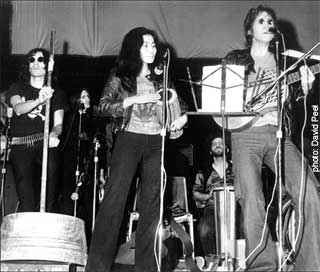
David Peel (left) performing with Yoko Ono and John Lennon. Don't Lennon and Peel sort of look alike? More on this later

John Lennon once compared Peel to Pablo Picasso. A bold proclamation, indeed. Well, similar to Picasso co-founding the Cubist movement, Peel definitely had a hand in providing some inspiration to the emerging genre of punk.

Peel and the Lower East Side band first recorded music in the late 1960s. They created a blend of “street rock” that targeted topics like marijuana and the police. It was fresh and attractive to the counterculture movement. Songs like “I Like Marijuana” and “Oink Oink” were obviously scorned by authority, but enjoyed by the youthful population that gathered in Greenwich Village. Peel and the Lower East Side band was actually among the first bands to regularly perform on cable TV in Manhattan. He appeared on the public-access cable TV channel of Manhattan Cable Television. He also performed at the first Smoke-in concerts at Central Park.

It was in front of a crowd at Washington Square Park in 1971 when Lennon first saw Peel. He was quoted saying, “He was shouting: why do you have to pay to see stars? I was embarrassed. I thought surely he must know we are here. Yoko and I love his hair, snazzy tight trousers and Hai Karate aftershave.” They quickly became friends and Lennon signed Peel to Apple Records where he promptly released The Pope Smokes Dope in 1972. The record was banned in nearly every country in the world, except for the US, Japan and Canada. I don’t believe this record was playing in cafes outside the Vatican. The fervor that Peel engendered is funny. It’s very…punk! And the music backs that statement up.

I mean listen to this. “Oink, Oink” was recorded in 1968. It is like Beach Boys meets the Ramones. And this was recorded when Dee Dee Ramone was 17 years old. Punk music is rooted in US garage rock and the New York underground (bands like the Velvet Underground). Peel, like Lou Reed, sang about drugs and unsavory NYC practices. In 1969 Protopunk was founded by MC5 and the Stooges (Michigan-based bands), but I do believe that Peel was a true predecessor of the burgeoning movement and, unfortunately, he does not get the credit he does deserve.

Peel and Lennon stayed close friends, Peel adopting Lennon’s thick-glasses style, and Lennon sampling Peel’s leather coat look (similar to retro Cavern Club Beatles). The two looked so much alike that Bob Dylan actually called a picture of Peel, John Lennon, and, because everyone takes what Bob Dylan says as the truth it seems, the FBI was also fooled. A picture of Peel was in Lennon’s FBI file. Lennon did help Peel become well known and he has performed with musicians like B.B. King, ELP and Alice Cooper. Peel still records music today and his full discography can be acquired. I suggest checking him out more. He is a punk visionary. And he recorded an album entitled The Pope Smokes Dope. I mean, come on.