Archive | Song of The Day RSS feed for this section

Having FUN with the Jukebox – Anthemic Indie

8 Mar

That's one FUN Jukebox

Whenever I think of a jukebox I think of “Happy Days.” This may be because I often watched re-runs of the show on late-night Nickelodeon when I was a kid. Now, though, I think of Jukebox the Ghost, a Washington D.C. spawned Indie pop band whose music partly sparks today’s post.

Yesterday, I profiled Giles, Giles and Fripp, and used their uniqueness to coin a genre of music (that really just combined a few genres together). I was inspired to do the same today. Jukebox the Ghost is just one example of a type of pop music that has become user-friendly in the music world. And I love it. Why? It requires actual talent. When someone says they are into Indie music they pretty much cast out a gargantuan net in a small pond. The genre “Indie” encompasses so many musical fish that two bands at the opposite end of the Indie spectrum may sound nothing alike. So, like all genres, we sub-categorize. Indie pop is still rather broad. Today we will discuss Theatrical Indie pop.

Theatrical Indie pop is the result of talented musicians creating highly infectious music that, while simple, is actually quite difficult to pull off. The music kind of feels like it can fit on a Broadway stage. The part about the talented musicians cannot be discounted. So you want to create Theatrical Indie pop music? You need an excellent singer with a high register, a skilled drummer, and a rhythm-sensitive guitarist. When all elements are fused together you get magic like this:

Jukebox the Ghost is Ben Thornewill (vocals & piano), Tommy Siegel (vocals & guitar) and Jesse Kristin (drums). They have become well known mainly because of their jocular rhythms, effervescent beats and personalities, and unadulterated musical happiness. It doesn’t hurt that since 2006 they have toured extensively. The band has released two albums since 2008 and expect another one in June. They work hard. They have also been noticed by acts like Ben Folds and Barenaked Ladies – they opened for both – and currently they are opening for Jack’s Mannequin on their Winter Tour.
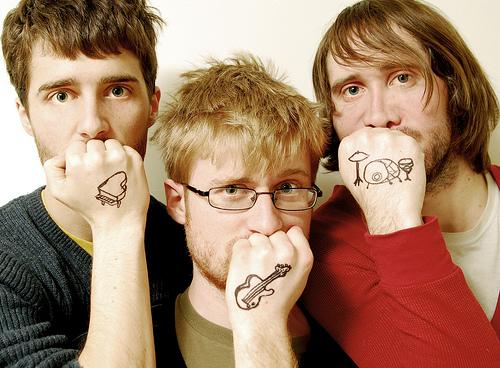
Jukebox the Ghost

“Hold it In” is off of the band’s first album. Simply, the song moves. The drums are friendly and the quirky keyboard is also amiable. The guitar rhythm follows wonderfully. Thornewill’s voice is perfect for this music. It is powerful and fits his elegant piano well. The chorus is where we see the “anthem” come out. Thornewill’s voice becomes almost schizophrenic (funny if you know their last album!) and it is paired with rhythmic clapping and single-word harmonies. The song continues similarly with even a neat guitar solo and it ends with a combination of all elements (and Thornewill’s effortless falsetto).

You may have noticed my capitalization of the letters in FUN. That is the name of the band I am featuring next. How convenient! Fun is a similar story. The New York based trio was formed by vocalist Nate Ruess, formerly of the Format. Ruess, like Thornewill, has a powerful, anthemic-like voice which features tremendous range and a true likeability. After The Format broke up, Ruess roused Andrew Dost (who plays everything and is in Anathallo) and guitarist Jack Antonoff (of Steel Train). They came together and thus far have also released two albums (the latest released just recently). The song that everyone knows is this:

This is the clearest example of Theatrical Indie pop. The song begins with Ruess singing over a basic keyboard riff that is contrasted with a loud drum march. And “by the time the bar closes and you feel like falling down, I’ll carry you home” BOOM! The song explodes (like the video) in this vocal anthem. You just feel like singing out the words immediately. There is some electronic stimulation, but this is mainly sparked by the band. The listener is hit with a guitar teetering on heavy. This combines with constant keys mixed with Ruess’ voice that can bring down walls. There is a reason why Glee covered this song. There is actually this Glee-like harmony that backs Janelle Monáe’s vocal solo and the pre-last chorus explosion. In a way it feels like you just sat through a Broadway show. And that’s the wonder of the genre, indeed.
Sailing with AWOLNATION

5 Mar

Monday may be coming to a close but since it is the beginning of the week I want to provide you all with a spark to get you through the rest of it. If you haven’t heard “Sail” by AWOLNATION, you will now and might also be left humming this infectious heavy indie/electro piece until the weekend. I know I couldn’t get it out of my head when I first heard it. So instead of delaying my insertion of the song, let me just provide you with the music so it can help make the rest of the post seem that much more awesome.

“Sail” is unlike any other song I have posted on this blog. Yes, Aaron Bruno, the frontman and leader of this project, does fuse familiar indie elements into this 4:20 bundle of paranoid energy, the song is still quite heavy and I think far more soulful and angry than M83, which can be looked at as a potential comparison. It first appeared on the band’s introductory EP titled Back from Earth, a worthy EP title because the top track, “Sail,” is inspired by a fictional extraterrestrial visit (or maybe it is all true!). The band released their debut album, Megalithic Symphony, in March of 2011. The band also features:

  • Christopher Thorn – lead guitar (formerly of Blind Melon)
  • Kenny Carkeet – rhythm guitar, keyboards, backing vocals
  • David Amezcua – bass guitar, backing vocals
  • Hayden Scott – drums

The best song on the full-length and EP is “Sail,” so let’s see why this untraditional song reached #82 on the Hot 100 charts and #5 on the alternative charts.

The song draws listeners in from the beginning with its simple staccato chord progression. The initial notes are catchy and this is important because right when you are being oddly lulled by this choppy progression, your ears meet a heavily distorted electronic factory noise that just explodes over a more complex version of the initial riff. Add in some percussion and this indescribable soulful yell of “Sail” and we have ourselves a song. Bruno’s voice is a true strength. A passionate rhythm can often drown out a vocalist, but Bruno’s reverbed voice is more powerful than the melody. It is also soulful. That is an element of this song that cannot be forgotten. While heavily distorted soul is not an established genre, Bruno pushes genre boundaries. His voice brings back the memory of blue-eyed soul singers.

The song itself infuses some neat elements I’d like to explore. At around 2:05, after the drums lead into a well-placed bridge, we get a traditional guitar echoing over the distortion and both background rhythms. A calm piano and harmony is then delicately placed over the hard-hitting rhythm. In a way, this reprieve is the calm before the storm. If you are following the video, you can see Bruno’s character hiding out from an inevitable abduction, and well, listen on.

We fall right back into it. All of the layers mash together in a composed mind-screw. Voices are placed over each other and the rhythm beats into you like a hammer. The elements fall off and Bruno starts to fly. The initial riff is heard above the distortion and drums. The song fades and ends.

“Sail” is a song you want to listen to a few times to appreciate all of the parts. I give it a big seal of approval for being revolutionary and so damn catchy! For more information about the band visit their website

Are you a Human Beinz? Out of the Cover Garage

7 Feb

In any era of fantastic music, great cover songs are frequently released. In the 60s, bands like the one featured today made their jump to fame by releasing covers of popular songs. Some covers from the 60s/70s are so well-known and well-done that it would surprise you to find out who originally recorded the song. I’ll name a few for the heck of it. “Feeling Groovy (The 59th Street Bridge Song)” was written by Simon and Garfunkel, but many prefer the version recorded by Harpers Bizarre. “Mr Tambourine Man” is, of course, recognized as a Byrds song, but it is a Dylan original. “You Shook Me,” and “I Can’t Quit You Baby,” on Led Zeppelin are Willie Dixon songs.

How about “Gloria” which hit the charts with Shadows of Night, but was written by Van Morrison and Them? Did you know another band named The Human Beinz also lent their sound to this hit, just after the Shadows of Night recorded the song? 

The Human Beinz thrived on covers. The band recorded covers of songs like “Foxy Lady” and “The Pied Paper.” They did hit it big with one of these covers in the United States, and then hit it really big with another cover in Japan. Actually, The Human Beinz was a 60s band that found more popularity in Japan then in the United States.

The Human Beinz were formed as the Premiers in 1964 and changed their name to the Human Beingz in 1966. They were a garage/frat rock band from Ohio formed by John “Dick” Belley (vocals, guitar), Joe “Ting” Markulin (vocals, guitar), Mel Pachuta (vocals, bass) and Gary Coates (drums).

Garage rock was big in Ohio during this time. Rick Zehringer (Derringer) was from Ohio and recorded “Hang on Sloopy” with the McCoys in 1965. Phil Keaggy and Glass Harp gigged in Youngstown, Ohio in 1968. Actually, and I love when you find out about incestuous rock relationships, Steve Markulin, Joe’s cousin, was in Glass Harp and left the band to join the Human Beinz.

The Human Beinz became the Beinz (instead of Beingz) because after signing to Capitol Records in 1967, their band name was misspelled, the g left out. In 1967 they hit it big with a cover of the Isley Brothers’ “Nobody But Me,” and the song kicked butt on the charts peaking at #8 in February of ’68. The name remained Beinz

It’s an awesome cover. They added rock flavor to an R&B song and did it well. I love the initial call and response that just makes you nod your head and move your legs. One of the strongest parts of the song is the defined bass guitar that carries the rhythm (even getting a brief solo prior to a buzzy guitar solo) along with repetitive claps and the repetition of “No.” The Isley Brothers loved repetition.

“Nobody But Me” was not their most popular song though. They released a cover of “Turn On Your Love Light” (recorded first by Bobby Bland in ’61 – and then covered by, you guessed it, Them, and the Grateful Dead).

A basic garage rock piece also carried by clangy drums, loud keys, vocal looseness, and a strong bass guitar. The song did not do much in the United States, but it reached #1 in Japan.

FUN FACT: “Nobody But Me” was used in Kill Bill: Vol. 1, and I would have included the video if it wasn’t full of black and white trademark Tarantino gratuitous gore.

Putting New Mexico on the Music Map – The Fireballs and “Sugar Shack”

1 Feb

Let’s travel back in time and explore some pre-British Invasion American rock n’ roll. For the past few installments of this category, I have featured a good amount of late 60s psychedelic/progressive acts and I do believe it is necessary to diversify. It is difficult for many who did not live during the 60s (or are familiar with the decade’s music) to believe that there was popular American music in the decade prior to the Beatles and the Rolling Stones. The “British Invasion” is known to have started in 1964 (even though you can put that date two years earlier when The Tornados had a huge hit in the US with “Telstar – let’s just keep it at 1964). There was a solid four years of rock n’ roll prior to this date.

The music was heavily influenced by 50’s rock n’ roll – poppy, bubbly, danceable, melodious. It’s fun, innocent, and clean-cut music. The musicians fit the bill as well. I think there is a charm to early 60’s music and I enjoy listening to vocalists sing about love, dating, and loss (there was a brief obsession with death pop – we will get into that another time). One such band that had success during this time was New Mexico’s The Fireballs, and their lead singer Jimmy Gilmer.

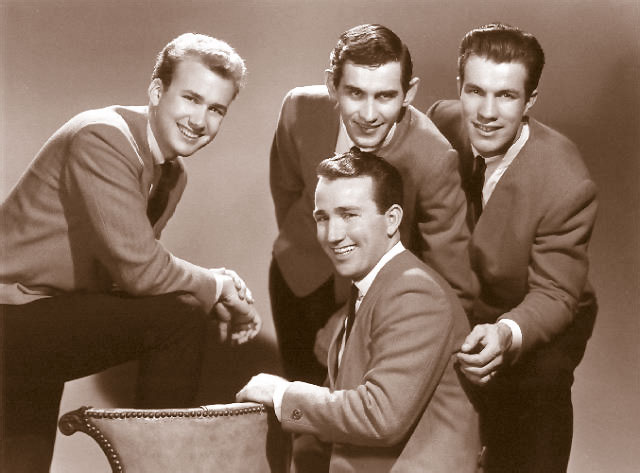
A lot of people just went, “OH! I remember this song.” Not surprising. This was a HUGE hit in 1963. Before we delve into Gilmer’s stylings, let’s look a bit at the band’s history. Like I said, they originated in New Mexico. George Tomsco (lead guitar), Chuck Tharp (vocals), Stan Lark (bass), Eric Budd (drums), and Dan Trammell (rhythm guitar), formed an instrumental band in the late 50s. They recorded and released a few semi-popular hits. After  Budd, Trammell, and Tharp left the group in the early 1960s, the group added Doug Roberts on drums and vocalist Jimmy Gilmer, a Texas-raised singer.

That line-up recorded the group’s most well known songs. “Quite a Party,” which peaked at #29 in the UK charts in 1961, was the band’s first true hit. In 1963, the band released “Sugar Shack” which saw a meteoric rise in popularity going to #1 for five weeks in the U.S.A., with 15 weeks in Billboard hot 100. The Fireballs became the first New Mexico band to ever have a #1 vocal song with “Sugar Shack.”

“Sugar Shack” is your classic ditty. It comes and goes with precision. The light-hearted keyboard riff is infectious and Gilmer’s voice, featuring a little Buddy Holly twang (Holly recorded in the same studio as the Fireballs, by the way), works well in the song.

Before I leave you, here is another song by the Fireballs from 1960. Notice the laid-back harmony and George Tomsco’s underrated, skillful rock n’ roll guitar.  I hope it makes you smile!

A Quick Post for the Road

31 Jan

I do not have much time to get a post in today. It has been one of those packed, busy days, but soon enough I will be on the road home. The “on the road” portion of this fact caught my attention for a brief song of the day. There are several options for “on the road,” but, since I would like to add some existential flavoring to my day, I’m choosing “Road to Nowhere” by David Byrne and his Talking Heads from their 1985 album Little Creatures.

The video above (so 80s) features constant movement and entrapment, eventually ending on a long stretch of seemingly endless highway. The video was directed by Byrne and Stephen R. Johnson, who also directed episodes of “Pee-wee’s Playhouse.” Also, just if you are interested in useless trivia, some of the shots were filmed at Stephen Tobolowsky’s house – who was Ned Ryerson in “Groundhogs Day” and, if you are a 14-year-old girl, Sandy Ryerson in “Glee.”

Not much else to say about the song besides that it is one of my favorites by the Talking Heads. Hope you enjoy the listen!