Archive by Author

Things to Never Do: Worst Album Titles

9 Mar

Album titles are tricky. Rarely are musicians able to both create landmark music and exceptional album titles. There are not many examples. Dark Side of the Moon is both a remarkable display of music and a tremendous album title.

So, what makes Dark Side of the Moon a good album title? Better yet, what makes album titles terrible?

Dark Side of the Moon holds a special quality in that it is referenced in the music itself, impeccably (may I add). But, taking only the album title into account, let’s analyze why it works. First, it is short and to the point. Often album titles drag on, but, in order to be effective, titles need to be catchy. Catchy generally means short and easy to remember. Why do you think the best rhythms are always the most simple?

Album titles cannot be overly pretentious either. For example, any album title that makes substantial claims like “this music is awesome” tells the listener that the music is going to be arrogant and condescending. It also will probably suck. And, on the opposite end of the spectrum, don’t be an idiot and misspell words. Seriously, do not!

Also, don’t you just hate album covers that are extremely nebulous and confusing? Seriously, who wants to be confused by the album title. It doesn’t make me want to buy an album. Think of some other great album titles. The White Album, Nevermind, American Beauty. Simple and straight forward. I like that. But, also, album titles that are just dumbed down like Madonna’s Music are terrible. Seriously, we know it’s music because it’s a freaking album.

Here are five album titles I dislike strongly.

1.) When the pawn hits the conflicts he thinks like a king
What he knows throws the blows when he goes to the fight
And he’ll win the whole thing ‘fore he enters the ring
There’s no body to batter when your mind is your might
So when you go solo, you hold your own hand
And remember that depth is the greatest of heights
And if you know where you stand, then you know where to land
And if you fall it won’t matter, cause you’ll know that you’re right
By, Fiona Apple
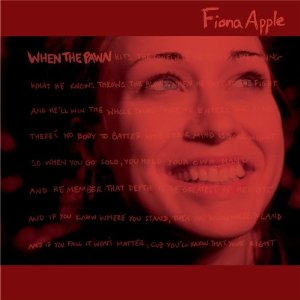
Yeah, I’m serious. This is the full album title. It is one of the longest album titles of all time. Chumbawamba has an 865-character album. Here is my issue with long album titles. I do not want to disparage Apple’s poetry, but it does not belong as the album’s title. Stick it in the liner notes as an addition. This is the opposite of a short, catchy album title. I wonder if anyone has memorized the full album title. Do those people refer to the album in full (as opposed to simply When The Pawn, the fragmented used title). Oh, did you hear the new Fiona Apple album. When the pawn hits the conflicts he thinks like a king… The abridged version is like Pi. Easier just to cut it to 3.14.

2.) The Ego Has Landed by, Robbie Williams

Robbie didn’t listen to me. This is beyond pretentious. He just flat out says that his ego has landed. Really?

3.) Julie’s Sixteenth Birthday by, John Bult
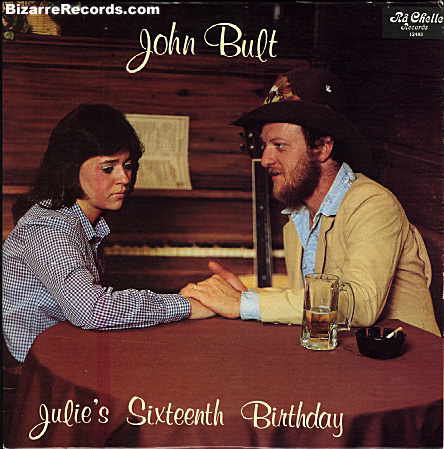
This takes the cake for two categories (like the b-day reference). The album cover is just weird, pedophilia-esque. This must have been a really bad birthday, like criminally bad. The album title is also terrible. Julie’s Sixteenth Birthday. How can that translate into good music? We are put in a place where we do not want to be, Julie’s horrible birthday party.

4.) The M-Pire Shrikez Back by Originoo Gunn Clappaz
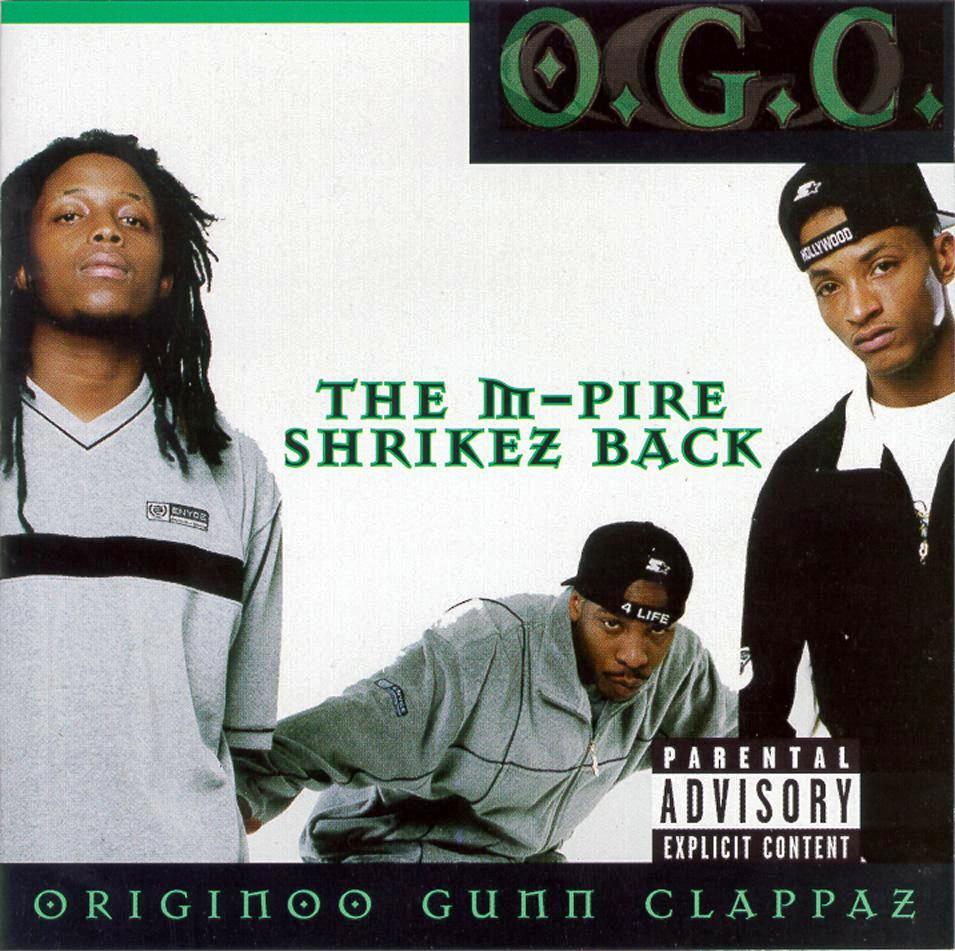
Well, the band name is spelled wrong, so I guess a misspelled title was sort of inevitable. But, really? I am not too worried with the M-Pire part. Hell, that is some creative input. But, shrikez. That’s not English, it’s gibberish. I don’t mind one misspelling, but a terrible one that makes no sense is inexcusable.

5.) Chocolate Starfish and the Hot Dog Flavored Water by Limp Bizkit
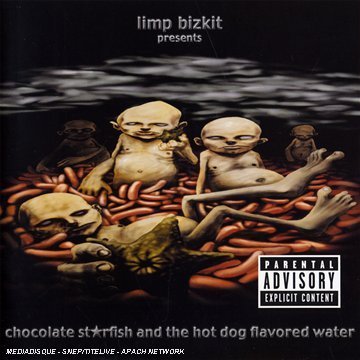
This album sold 1.05 million copies in its first week. Chocolate Starfish and the Hot Dog Flavored Water. This has to be the worst album title ever. It does everything wrong. It is not catchy, it’s stupid and it completely turns you off to everything. It is just gross. Why are we talking about hot dog flavored water. We should never talk about that. And look at the little people on the album cover. They are bathing in hot dogs. Why? This is the quintessential example of the confusing album title. What the hell does this mean? Not much, obviously. I mean it is Limp Bizkit

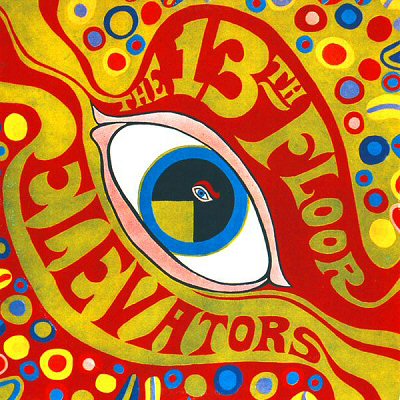
“You’re Gonna Miss Me” by 13th Floor Elevators – Early Psychedelic Garage Rock

8 Mar

Okocim issued a challenge in his last post. He posed the broad question, what is the 60’s psychedelic music? As a single question, I believe it is impossible to answer. The genre expanded into many sub-sections and there is not one sole example of 60’s psychedelic music that I can give to him and say this is your answer. The sub-sections make 60’s psychedelic music unique. Because, in itself, psychedelic cannot be a genre. Psychedelic becomes a genre when it pairs with a type of music (like rock or pop). Therefore, the music is always perpetuating more sub genres because in order to survive it needs to. Following my thinking?

This is why I find psychedelic music (specifically of the 60s variety) to be so intriguing. Psychedelic, in itself, can be esoteric and abstruse. In order to make rock or pop psychedelic, a musician needs to add an oddness to the melodic structure, thereby expanding the listeners mind. Yes, a lot has to do with drugs, but a perfectly sober listener (like myself) can get just as much out of it. The music itself is a drug.

I could not turn down Okocim’s challenge though. I proposed in my comment to him a new sub-section of “Journey To The Center of the Mind” called “The 60’s Psychedelic Experiment.” Damn, this post already sounds like “Inception,” a section inside a genre inside a section. That is what psychedelic music is, in a way. It delves deep into music’s structure, like a genetic mutation, and morphs it into something different (either slightly or tremendously).

I am going to answer Okocim’s question of what is 60’s psychedelic music by exploring different songs by different artists over the course of several weeks, answering the question of what makes it “psychedelic” and what specific genre it finds itself swimming in. We begin with one of the aboriginal psychedelic bands, hailing from Texas (starting in 1965), the 13th Floor Elevators.

At the beginning of the psychedelic rock revolution, the psychedelic garage rock component was strong. Garage rock is generally raw and easily tourable. It needs no special studio effects and is solid the way it is. This made it an easy for psychedelic music to manipulate. It was not the first of its kind, this still being reserved for psychedelic folk that came on the scene 1-2 years earlier. But, it is the first example of psychedelic rock. The Cream and the Beatles would explore psychedelic attributes in their music at around the same time, but of the limited examples of 1965-66 psychedelic music, “You’re Gonna Miss Me,” the 13th Floor Elevators 1966 single, is the best example of early psychedelic garage rock (a sub-section of a sub-section).

Now when I say garage rock, I am talking about the genre that formed in the late 50s, but really blossomed in 1963. Think of “Louie, Louie” by the Kingsmen. It is that ol’fashioned rock. That’s why many consider garage rock to be the distant ancestor of punk, because of its chordal simplicity.

13th Floor Elevators came on the scene two years after garage rock’s blossoming and they transformed the genre with a psychedelic component.

The question posed by Okocim is basically what makes this (and any other song during the time period) 60’s psychedelic and how did it help form the term “60’s psychedelic music” which is just way to large to ever conquer.

Well, the first four chords sounds like a variation of the Yardbirds “For Your Love” which was released a year earlier. The guitar is amplified with a little reverb and a slight echo. Their bluesy sound is original. Billy Gibbons of ZZ Top cites the guitar work as inspirational.

At around 6 seconds, you hear this muffled noise in the background of Roky Erickson and Stacy Sutherland Gibson guitars. That is an electric jug of Tommy Hall. Hall created vocalized sound with the jug that gave each song an underground stutter. This is paired with Erickson’s powerful voice (with bluesy screams).

Hall also inspired band members to record and perform music while on LSD, which was unique during the time.

The best psychedelic rock example occurs at the breakdown at 1:30. Listen to the combination of time. The electric jug competes with the drums while the voices sing “I’m Not Coming Home.” This takes in the psychedelic effect. The jug combined with the reverbed guitars do this. It is garage psychedelic because it is simple, but, it is different from typical garage rock examples because it adds different elements that make the music more acid-inspired and art-based.

Jeff and Rod To Play The Blues – Simon Tours So What – Supergroups of the 21’st Century

7 Mar

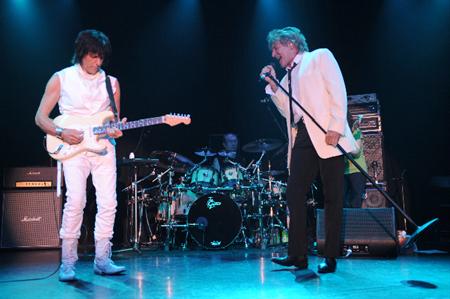
Jeff Beck Plans Blues Album with Rod Stewart

Link: http://www.reuters.com/article/2011/03/04/us-jeffbeck-idUSTRE72350Y20110304?feedType=RSS&feedName=entertainmentNews&rpc=22&sp=true

Jeff and Rod

Most people know Rod Stewart as the small singer who made our mothers swoon. Well, before Rod Stewart even joined Faces prior to his illustrious solo career, he was Rod the Mod, lead vocalist of the Jeff Beck group, and his excellent voice was used for gritty blues. Yes folks, Rod Stewart is/was a blues singer. And Jeff Beck has plans to bring that Rod Stewart back.

“It all depends on how he delivers,” said Beck. “He’s gotta come across big-time, vocally. But until the fat lady — uh — the skinny geezer sings!”

Beck, in an interview with Reuters, talked about how he plans on recording a retro album with Stewart, but requires the album to be mind-blowing or it will not hit the shelves. Rod Stewart helped Beck formulate perfect blues experimentation projects. But, then he left and ended up recording “Maggie May.”

“There’s nothing wrong with ‘Maggie May,’ but it would have been so much more powerful, I think, more strident, more futuristic,” said Beck. “But who am I to say? Look at the results he got.”

Do I smell blues reboot of Stewart’s classic? Probably no, but how awesome would that be. Pretty awesome, I think.

—————————————————————————————————————————————————————————

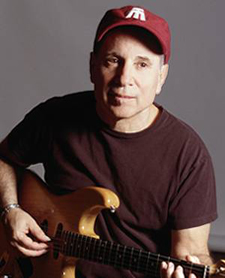
Paul Simon’s Spring Tour


In celebration of his new album So Beautiful or So What (and now the post title makes sense), Paul Simon announced a Spring tour that will hit cities from Seattle to New York.

The album, Simon’s first in five years, was called, “His best since Graceland,” by Rolling Stone. Graceland was released in 1986 and won the Grammy for Album of the Year. So, basically, the album is good.

The tour will draw from his entire career. The dates are below:

4/15 — Seattle, WA, WAMU Theater
4/20 — Los Angeles, CA, Pantages Theatre
4/21 — Los Angeles, CA, Pantages Theatre
4/25 — San Francisco, CA, Davies Symphony Hall
4/26 — Oakland, CA, Fox Theatre
5/2 —  Minneapolis, MN, Minneapolis Convention Center Auditorium
5/6 —  Toronto, ON, Massey Hall
5/10 — New York, NY, The Beacon Theatre
5/11 — New York, NY, The Beacon Theatre
5/17 — Chicago, IL, Chicago Theatre
5/19 — Nashville, TN, Ryman Auditorium
5/22 — Gulf Shores, AL, Hangout Festival
5/25 — Washington, D.C., DAR Constitution Hall
5/28 — Atlantic City, NJ, The Borgata
5/29 — Mashantucket, CT, MGM Grand Theatre @ Foxwoods
6/1 —  Boston, MA, Wang Theatre

—————————————————————————————————————————————————————————

Paste’s Noticeable Supergroups of the 21’st Century

Link: http://www.pastemagazine.com/blogs/lists/2011/03/best-super-groups.html

We have experienced 11 years of the new century thus far. During those years, new supergroup combinations have rocked onto the scene and Paste decided it was time to profile 11 of them. I have no problem with that. Supergroup extraordinaire Danger Mouse appears on the list twice, no surprise. So, here is how I am going to break this list down. You can check out the list in full following the link above, but I am just going to post a supergroup that you should check out, and one I did not know existed but want to check out.

First one that you should check out.

Broken Bells

Broken Bells consists of Danger Mouse and the Shins’ lead man James Mercer. Their sound combines folk/indie rock with synth effects and Danger Mouse’s zany production, organized but, at times, psychedelic. Mercer’s voice is perfect for the group. Here is my favorite song by the two.

Check out my analysis of the song: https://musiccourt.wordpress.com/2010/12/25/the-best-songs-of-2010-5-the-high-road-by-broken-bells/


And now a group I have not heard of but would like to check out.

The Baseball Project

When did Steve Wynn and Peter Buck get together? That is just uber-awesome. Apparently, the band was formed four years ago after Wynn and Buck had a conversation at REM’s Rock n’ Roll Hall of Fame induction. Their second album, Volume 2: High and Inside, was released earlier this month.

Here they are on Letterman promoting their first album which was released in 2008


Thursday Morning Psychedelia

3 Mar

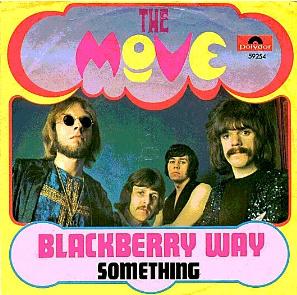
Generally, Thursday’s are reserved for music news, but in viewing the stock of potential items I have decided that none of it is that exciting. Billy Joel’s memoir is coming out in June. That’s about it. So, instead of boring you all with unexciting news items, here is The Move performing my psychedelic song choice of the day, “Blackberry Way”

Yes, that is Roy Wood, who would form ELO after his stay with the Move. Wood wrote “Blackberry Way” as a response to the Beatles’ “Penny Lane.” As you can hear, it is gloomier and definitely more strung out. The singer is Carl Wayne whose accented voice works perfectly for the song.

Ever since first hearing this song, I have always liked something about it. It does not blow you away. It is very weak on the psychedelia, even though it does fit into the category of Psychedelic Rock. Perhaps, it is the song’s simplicity that I enjoy. It was The Move’s most successful single (reaching number one on the UK charts). I believe it garnered such attention because it was not an over-the-top release. It is what it is and what it is, is good.

The Spell of Shock Rock: Screamin’ Jay Hawkins

2 Mar

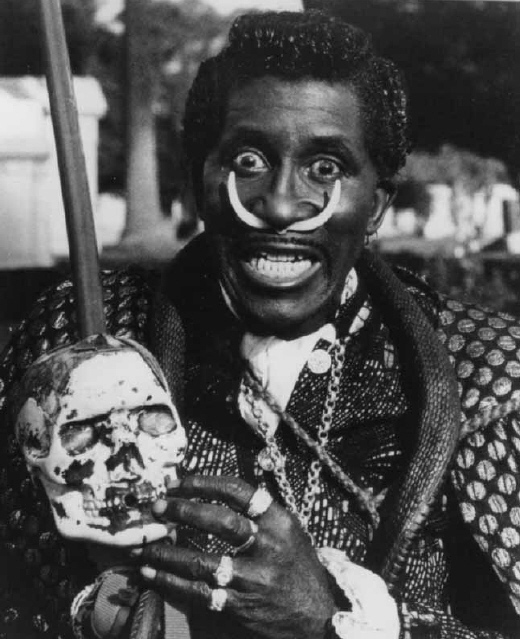
Screamin Jay Hawkins

People who view the Music Court frequently know that I am a big fan of the roots of rock n’ roll. No, not the house band for Late Night with Jimmy Fallon. I’m talking about musicians who inspired famous artists to perform. Rarely do you get to label someone as the sole progenitor of a certain genre, but for the maniacal genre of Shock Rock, one particular forefather sticks out. When Alice Cooper, The New York Dolls and Kiss talk about inspiration they often site Arthur Brown and Screaming Lord Sutch. But when Arthur Brown and Lord Sutch talk about their inspiration, one man sticks out as the man behind Shock Rock. That is the man above. Screamin’ Jay Hawkins.

Everyone knows shock rock. It is the wild, hyperbolic genre that sees musicians dress in costume and put on a theatrical act for the crowd. The songs are over-the-top, sometimes marked by yells and guttural noises. No one did this better than Screamin’ Jay. Not only did he create the genre, but also because he was so absolutely fantastic at performing it, no one could ever reproduce his sound.

Screamin’ Jay Hawkins was crazy; a solid background for shock rock. He served in the Air Force during World War II and claimed that he was tortured. One story states that upon being liberated, he taped a hand-grenade to his torturer’s mouth and pulled the pin thereby blowing his head off. He also was a boxing champion in Alaska. He was born in Cleveland.

On stage, he began to be known for his gaudy stage outfits, adorning himself in leopard skin and leather. His main influence to shock rockers lies in his performance of “I Put a Spell on You” which is one of the most influential rock songs ever. And, no, that is not an exaggeration.

The song, which was originally supposed to be a blues ballad, turned into an inebriated donnybrook of painful groans, wide-eyed stares and an evil repetitive riff that is both scary and infectious. In layman terms, the entire band was drunk when they recorded the song, and what was once a love song turned into a lascivious, demonic ritual. He doesn’t even remember recording it because he blacked out after. But it is sweet, sweet music to my ears.

It is absolute genius. This is what inspired the shock rockers. This extravagant display of sexually charged music was preposterous in 1956, when the song was released. Carl Perkins had just released “Blue Suede Shoes” and Screamin’ Jay Hawkins was releasing this transmogrification of the blues. He was 12 years ahead of his time. Blues would once again feature songs like “I Put a Spell on You,” but not at Hawkins’ level. Hawkins continued to take his act to new levels and that can be seen in his performance below. This is music!