Archive | Lyric of the Day RSS feed for this section

Lyric of the Day #74: Top 100 Lyricists #73 – Michael Stipe (REM)

10 Feb

We have reached a milestone. Finally, the number of lyrics of the day has surpassed the number of lyricists we are up to. What does that mean? Well, absolutely nothing, but, at least in my mind I feel that we are accomplishing something with this section. So, is there a better way to celebrate than with the lyricist of the day Michael Stipe.
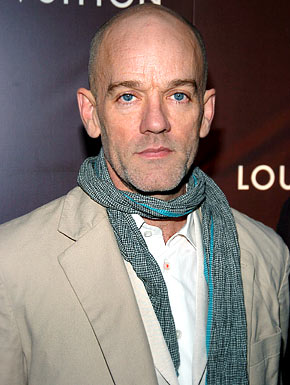
There was a string in the 1990’s between the years 1991-1998 where Michael Stipe and his Athens, Georgia based band dominated the U.S charts. Five albums, three 4x platinum, one platinum, one gold, hitting a peak position of two chart 1’s, two chart 2’s, and one chart 3. The songs released on these albums were the absolute best rock work on the 1990’s hands down. Let’s say you want to start with Out of Time released in 1991. “Losing my Religion” (which will be featured a little later in this write-up), “Radio Song,” “Shiny Happy People,” were all released on this album which sold over 10 million copies worldwide. Shoot forward seven years (keep in mind that seven years was the span of albums released from the best band ever The Beatles (1963-1970). R.E.M., only having lost the services of drummer Bill Berry, recorded UP which sold around 661,000 units in the U.S. and featured such songs as “At My Most Beautiful” and “Daysleeper.” R.E.M. is a strong band and Michael Stipe is a very strong lyricist.
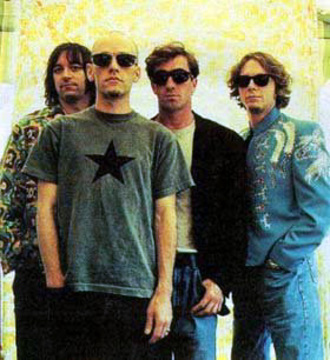
John Michael Stipe was born in Decatur, Georgia. As a military brat his family was often relocating and after graduating from a high school in Illinois he chose the University or Georgia for college where he studied art. While in college he often went to a record shop where Peter Buck, guitarist for R.E.M., worked as a store clerk. Buck liked his odd record choices and eventually the idea of starting a band came to fruition. R.E.M. was selected from a dictionary and the other two band members, Mike Mills, and Bill Berry, joined completing the quartet.

Out of Stipe’s body of lyrical work there are two songs in particular that I think perfectly display his talent. These are “Losing My Religion” and one of my person R.E.M. favorites “Nightswimming.”
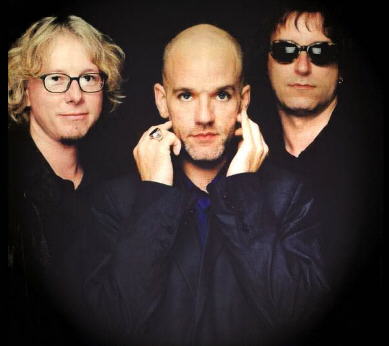
“Losing My Religion,” which is widely regarded as R.E.M.’s best work (both music and music video), emits a magical feel while listening to it. It is a great song without lyrics, a strong mandolin played by Peter Buck and an equally strong acoustic guitar and electric bass carry the song. Yet, what gives “Losing My Religion” the wow factor is Stipe’s croon and the lyrics that work perfectly with the riff. My favorite line from the song is:

“Every whisper
Of every waking hour I’m
Choosing my confessions
Trying to keep an eye on you
Like a hurt, lost and blinded fool
Oh no I’ve said too much
I set it up”

There has always been much debate about what Stipe was attempting to explore in this lyric. Many people claim that it is not about religion at all. The term, losing my religion, is actually a southern term meaning losing one’s temper or being at the end of one’s rope. With this evidence I believe that the song strongly suggests a bad break-up and a man’s constant struggle of trying to hold on or “keep an eye on you” while not wanting to say too much. Stipe himself has called this song classic obsession pop song like “Every Breath You Take.”

“Nightswimming” is a little bit of a different story. The song is nostalgic and beautiful. Stipe sets a scene and we can visualize the naked bodies in the water. The first verse has always been my favorite in this masterpiece.

“Nightswimming deserves a quiet night.
The photograph on the dashboard, taken years ago,
turned around backwards so the windshield shows.
Every streetlight reveals the picture in reverse.
Still, it’s so much clearer.
I forgot my shirt at the water’s edge.
The moon is low tonight.”

It is idyllic and the truthful grasp of the song is intoxicating. Stipe hits a soft spot and makes it stick, his main skill as a lyricist.

Lyric of the Day #73: Top 100 Lyricists #74 – Joshua James

27 Jan

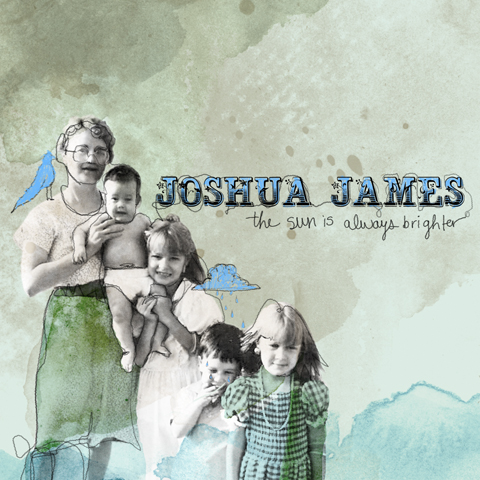
Joshua James, the young folk troubadour from Lincoln, Nebraska, is certainly on the rise. Since 2006 he has released 6 albums, only two of them EP’s, and he has sparked some major recognition from magazines that focus on judging young singers and song-writers. Variety Magazine has called James, “a young Midwestern singer-songwriter who writes hard-bitten songs of family tragedies and sings them in a voice that’s as sun-bleached and wind-battered as a Nebraska cornfield,” which is most certainly some eloquent high praise. Paste magazine has named him one of their “Next 25 Artists You Need To Know” in their September, 2008 edition. He has even gotten the support of his fellow musicians who recognized his talent and wanted him to help their North American Tours. On that names list is Brett Dennen, Ani DiFranco (oddly Top 100 Lyricists #75), David Gray, and John Mayer. Putting all the recognition and praise aside I can tell you truthfully that he is one of the more exciting artists in a long time and his lyrical prowess is in the top 5 of below-40 artists scribbling songs.

James, currently based in Utah, grew up in Nebraska with strict parents who banned certain music. Of course, like any rebellious child, James constantly sneaked listens and developed his own musical longing and ability. In using music as a therapeutic connection, James began writing songs about the world around him and the people in it. His ability to delineate human struggle and emotion is certainly uncanny, but, what shoots him above other lyricists able to evince emotions is his remarkable hold of the English language and the cadence in his lyric. Let’s look at the opening verse in James’ song “Soul in the Sea” which you can also listen to below the lyric.

“I dream of dusty roads, paved with gold that lead me in your eyes.
The marmeladed paintings sing a song that not the crows will try.
The Piano screams a sound inside your lips I have found,
Something I could never save.
The current pulls me down, into your river deeper now, than I had
Ever planned to sink, planned to sink”

Not only is the song catchy and the melody calm and beautiful, but, as you can see above, the lyric reflects it. “Dusty Roads,” “Marmeladed Paintings” “The Piano Screams a Sound.” The description is effulgent and even James’ personification in the piano screaming is original and shocking. Shocking is the name of the game with James’ next song “Lovers Without Love” where he explores truths in our society.

“Love and hate can not see colors,
like the human eyes,
so priests and preachers, parents teachers,
don’t act so damn surprised

its the world we’ve made and living in
of greed lust and poverty,
of war and pride, teen suicide,
and lovers without love like me
from topless dances to Marilyn Manson
and lovers without love like me.”

In what seems to be an attack on those who claim ignorance in our world, James explores how we all spot the distinct color of hatred in this world that we are living in. We have greed, lust, poverty, war, pride, teen suicide and lovers without love. It is a list out of the Seven Deadly Sins and it is unfortunately true. James is able to express this, like everything else he does, with a Midas touch.

Lyric of the Day #72: Top 100 Lyricists #75 Ani DiFranco

19 Jan

“If folk music has a future it’s Ani DiFranco.”

The next artist on our best lyricists countdown is Ani Difranco. A beacon in both the folk and alternative scene, Difranco rose to public consciousness in Buffalo, New York, in the early 1990’s. She boldly started her own record label Righteous Babe in 1989, and ever since has remained a trailblazer, redefining the image of the modern woman. Difranco’s lyrics are reputably potent with soul and are true expressions of emotion and heartache.

Difranco has managed to release 20 albums within her career, and in this time, proved herself to be a feminist icon. She has historically turned down lucrative record contracts and the spotlight of mainstream media, valuing the artistic freedom inherent within her own label. Such integrity and craft is unfortunately a rarity in this day and age.

While fishing around through her massive catalogue, one song of Difranco’s seemed to stand out. It was the Not a Pretty Girl, released back in 2002 (Difranco has since produced music more recently as well). The opening lyrics are biting yet funny at the same time:

I am not a pretty girl
that is not what I do
I ain’t no damsel in distess
and I don’t need to be rescued
so put me down punk
maybe you’d prefer a maiden fair
isn’t there a kitten stuck up a tree somewhere

The song is pretty unconventional in the sense that she seems to “talk” out the lyrics.  Nonetheless, it is beaming with experience and a collective pain. She comes off jaded, dismissive of society’s popular approach towards women.

With a career based on manic touring and a college following, Difranco continues to be an unstoppable force.

Lyric of the Day #71: Top 100 Lyricists #76

12 Jan

A troubadour by definition is a folk singer. By that broad definition one can think of many musicians who fit the qualification of a troubadour. Bob Dylan, Woody Guthrie, Phil Ochs, Joan Baez. Yet, there is only one man who can qualify as the “Hardcore Troubadour,” and that is a title that was bestowed upon Steve Earle, #76 on our list of top 100 lyricists.

Why hardcore? Well, Steve Earle is a folk/country rebel. He is your quintessential travelling folk man who never settles in one spot and has a tremendous list of works. Yet, what makes him hardcore is his ineffaceable liberal political viewpoints and his troubles with the law because of constant drug use which he finally kicked in the early 1990’s. He has also been married seven times (twice to the same woman) which explains that he is probably not the easiest man to live with. Putting everything aside though (because this is a music site), one must look at his lyric poetry to understand that the “Hardcore Troubadour” is a lyrical master and well deserving of his spot on the list.

Hailing from Texas, Earle dropped out of high school in the 9th grade (really did not give that much of a chance) in order to learn more about the music business in 1975. What the music business quickly noticed about Earle is his ability to write lyrics. He was employed as a songwriter by RCA and wrote songs for Johnny Lee, Vince Gill, Patty Loveless and even Mr Blue Suede Shoes himself, Carl Perkins. Despite his success with lyrics he had to wait until 1986 before his first album “Guitar Town” was released. “Guitar Town,” ranked 489 out of the 500 greatest rock n’ roll albums of all time according to Rolling Stone Magazine is a solid country album expressing Earle’s lyrical prowess. “Guitar Town,” the title track of the album of the same name, demonstrates the excellent setting that Earle is able to concoct in his songs.

“Everybody told me you can’t get far
On thirty-seven dollars and a jap guitar
Now I’m smokin’ into Texas with the hammer down
And a rockin’ little combo from the Guitar Town

Hey pretty baby don’t you know it ain’t my fault
I love to hear the steel belts hummin’ on the asphalt
Wake up in the middle of the night in a truck stop
Stumble in the restaurant, wonderin’ why I don’t stop

Gotta keep rockin’ why I still can
I gotta two pack habit and a motel tan
But when my boots hit the boards I’m a brand new man
With my back to the riser I make my stand

And hey pretty baby won’t you hold me tight
We’re loadin’ up and rollin’ out of here tonight
One of these days I’m gonna settle down
And take you back with me to the Guitar Town”

I picked a large segment here because I feel that cutting the song short would have been a disservice to Earle’s lyric. With lines like “two pack habit and a motel tan” and “thirty seven dollars and a jap guitar” Earle represents the traveling musicians lifestyle with excellent precision. The song is a story…like it should be.

Earle’s political positions are unavoidable and obvious. He was very anti-bush, and still maintains a strong stance against war and the death penalty. In his song “The Revolution Starts Now” he sings about the “War on Terror” and the fear that is being spread by what Earle sees as warmongers.

“The revolution starts now
When you rise above your fear
And tear the walls around you down
The revolution starts here
Where you work and where you play
Where you lay your money down
What you do and what you say
The revolution starts now
Yeah the revolution starts now”

From a sheer lyric standpoint the verse is very crafty and that is the strength of Earle’s ability. He is a crafty lyricist who is able to mold words well and “Hardcore Troubadour” or not, he is well deserving of his spot on this list.

“Guitar Town”

Lyric of the Day #70: Top 100 Lyricists #77

5 Jan

A good Tuesday morning to everyone in the blogosphere. I am lying on a couch currently watching the Jason Bay news conference announcing his signing. As a Mets fan these are usually the most optimistic times of the season; pre-season mornings where established players don the blue, white and orange for the first time (well for Bay he came up in their farm system for a little while so that is not entirely true). On September 20th, 1976, Stephen Stills reunited for one album with Neil Young in the post-Crosby Stills & Nash era. Both proved to be prophetic in their song “Midnight on the Bay” (even though Young wrote the song). The song has the line “Midnight on the bay, sure feels good to be.” Two years later Jason Bay was born on September 20, 1978 and his signing with the Mets sure feels good to me.

The album that was prompted by Stephen Stills, the consensus 28th Greatest Guitarist of All Time voted on by Rolling Stone Magazine. Stills is a fantastic musician. The man has succeeded with Buffalo Springfield as a versatile guitarist who combined his acoustic/folk background with his blues and latin music foundation (the blues was inspired by his friend Jimi Hendrix who is just an okay guitarist). After Buffalo Springfield started falling off Stephen Stills moved on to form one of the first Supergroups with David Crosby of The Byrds fame and Graham Nash of the Hollies. Crosby Stills & Nash (& sometimes Young) just released back to back #1 albums so that is not a big deal or anything. Stephen Stills, while being a tremendous guitarist also wrote lyrics. The men of Crosby Stills & Nash shared the lyric responsibility and Stills, who flourished under Buffalo Springfield, wrote several hits including the first song which we will profile, “Love the One You’re With”

“Well there’s a rose in the fisted glove
And eagle flies with the dove
And if you can’t be with the one you love honey
Love the one you’re with”

This chorus is universal (well at least the last part which is often yelled out at concerts during the song…that and the doo doo doo doo part after it). It is just a very simple message by Stills which works perfectly. The song was quite successful and is still a noticeable song in the classic rock community today. It is a catchy lyric and Stills was able to capitalize on it. Yet, Stills’ best song is most definitely the renowned “For What It’s Worth” which is simply one of the best and most famous anti-war songs of all time.

“Paranoia strikes deep,
Into your life it will creep.
It starts when you’re always afraid,
Step out of line,the men come and take you away.

We better stop,hey what’s that sound,
Everybody look what’s going down”

This is my favorite portion of the song because of its truthfulness. There is no cryptic message or subtle hits at politicians or war. Stills is not afraid to state his opinion. War will come and take you away, cut and dry. Stills is just confidently and his lyric proves it strongly.