Archive | Musical Interludes (Melodic thoughts from the Jester) RSS feed for this section

“Heel Turn 2” – New Release off of Mountain Goats’ Upcoming Beat The Champ

1 Mar

mountaingoats-heel2

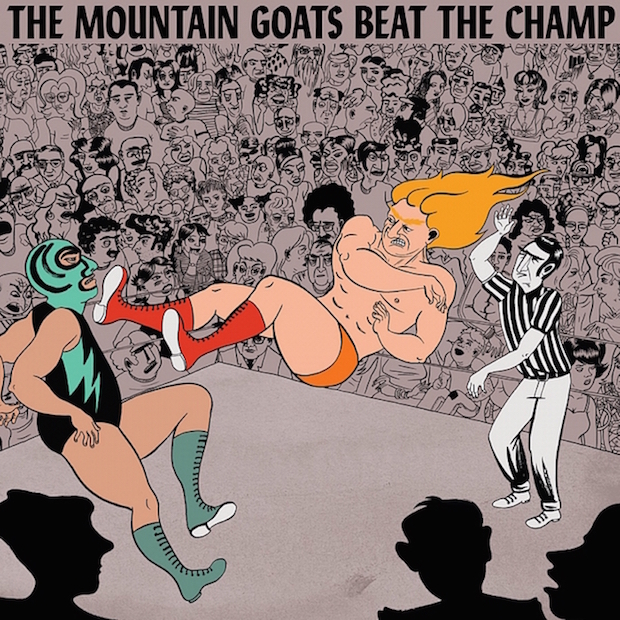
Yes, unfortunately we have to wait until April 7 for Beat The Champ, The Mountain Goats’ 15th LP, to be released in the U.S. While we patiently await John Darnielle’s ode to wrestling and “death and difficult-to-navigate interior spaces,” Darnielle is slowly releasing a few tracks off the new album. Today, Darnielle leaked “Heel Turn 2”. Let’s take a listen.

Readers of the Music Court know that I am a big Mountain Goats fan. There is a reason why The Mountain Goats frequent my iTunes favorites list more than almost every band I have music from (second to the Beatles, which is a heck of a compliment). Beat The Champ is the first Mountain Goats release since 2012’s Transcendental Youth. The Mountain Goats do have the unique ability to record consistently incredible albums. It’s tremendous. Darnielle never has a let-down.

“Heel Turn 2” is a classic Darnielle track. It bounces with a driving acoustic guitar and poppy percussion. This is supplemented with some creative instrumentation – lounge piano and ethereal guitar. It’s melancholic (“I don’t want to die in here” is a lyric) and dulcet. The song is almost split into two pieces – one a Mountain Goats standard and the second a lugubriously beautiful piano piece. Heck of a song!

Smallpool’s Melodic LOVETAP! – 2015 Album of the Year Finalist … Already?

19 Feb

unnamed-2

Fans of Los Angeles-based quartet Smallpools could have told you two years ago – after the band’s debut self-titled EP – that its first album would immediately become an Indie Alt/Rock finalist for Album of the Year whenever it dropped. Smallpool’s effervescent electricity shoots through its songs like a electric charge to water, and the result is musical lightning buzzing through your veins with an ecstatic, toe-tapping vibe. Now, almost a month away from LOVETAP!, Smallpool’s debut release set to be dropped by RCA records on March 24, I cannot hold myself back any longer with the effusive praise.

Smallpools has East Coast roots; Mike Kamerman (NJ) and Sean Scanlon (NY) flew away from the cold weather to sunny L.A. to pursue music, and there they met Joe Intile and Beau Kuther, who together combined to form Smallpools. May of 2013 saw the release of the band’s first single – “Dreaming” – track 3 on the album – and “Dreaming” quickly reached #1 on the Hype Machine and #23 on Billboard’s Alternative Songs chart. The band shot out an EP in July of that year and found even more success, having songs featured on FIFA and by Snapchat. The success found tours, and the band has supported Indie staples like San Cisco, WALK THE MOON, and Neon Trees. It’s about time that Smallpools is the main act.

So, what will you hear on the album. Check out this track (above) entitled “Karaoke.” This, the first single off the album (released in November of last year), is an ebullient track with stuttered synth, 80’s-like keys, and energized vocal harmonies. It is beyond just superficial pop; there is true quality to Smallpool’s melodies – there is a passionate strength to this tune, and that is consistent with all of its tracks. I’m drawn to when the track is stripped down to its bare elements – a moment of vulnerability that is refreshing.

“Over and Over” is my favorite track by Smallpools. It is a perfect pop song. A sub-3-minute power piece that meshes elegant synth, echoed vocals, creative percussion, and a tremendous hook. The song meshes Colony House, Grouplove, and even some Jukebox the Ghost into a killer track that is repeat-worthy.

Get ready to hear a lot more of Smallpools – I’m just fine with that!

Check out more about the band on its Website, Facebook, and Twitter

Halftime at the Super Bowl – The Creation

31 Jan
carol_channing_1972_01_16

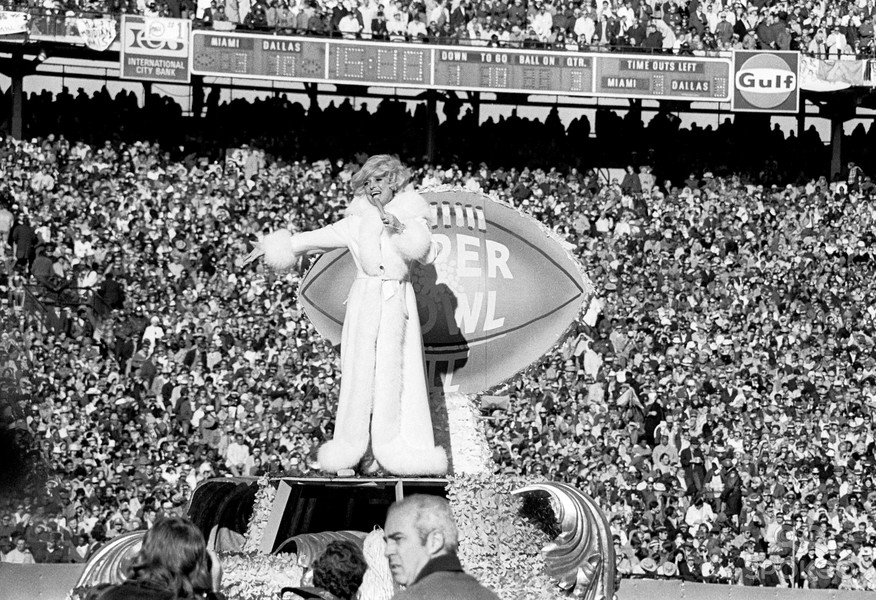
Carol Channing at Super Bowl VI

Halftime at the Super Bowl has transformed into the pinnacle of music stardom. You know you have made it when you grace the over-produced light-show of the Super Bowl. Well, my guess is you are aware that you have made it far before the Super Bowl. Acts like Bruno Mars, Beyonce, Madonna, and the Who have performed at the grand American affair since 2010, and pop songstress Katy Perry will team up with Lenny Kravitz in Arizona tomorrow (hopefully after a Seahawks smash-down first-balf of football – sorry Jets fan here). But was the Super Bowl halftime show always such an illustrious affair? Did you know the first Super Bowl halftime show was performed by none other than the University of Arizona Symphonic Marching Band?

So, when did the Super Bowl halftime show become must-watch television? Well, keep in mind that the Super Bowl has grown as an event as the NFL has grown in popularity. For many years, though, the Super Bowl was a themed affair with marching bands and cheer teams. In 1993 the NFL (and its sponsors) learned how TV ratings generally increase when you shove a superstar in front of the cameras and say sing. It was the King of Pop, Michael Jackson, who turned the production into, well, a real production. After MJ’s 1993 show at the Rose Bowl, the Super Bowl started to attract some major talent, and today it is arguably the most watched event and easiest way for artists to get their music to oodles of drunk and overstuffed viewers.

Way before MJ, before the Super Bowl halftime show transformed into the massive spectacle we will all view tomorrow, there was one famous performer who graced the Super Bowl stage, becoming the first true singer to be featured at a Super Bowl (minus Carol Channing, who is pictured above at this Super Bowl). Before the King there needed to be a Queen.

Super Bowl VI – Jan. 16, 1972 at the late Tulane Stadium. As a salute to the revered Louis Armstrong, who passed away in June of 1971, Ella Fitzgerald played an excellent set. I don’t have a video of the SB, but here is Ella with Louis performing “Summertime”. Check it out and enjoy the big game tomorrow!

Capitalism and the Legacy of Bob Marley: An Influential History

17 Jan

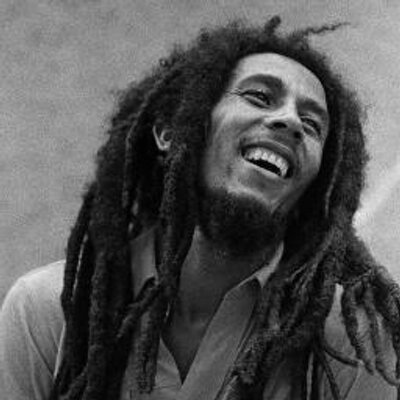
We have a special treat for you this Saturday morning on the Music Court. Guest writer, Beth Kelly, provides her take on the unfortunate commercialization of Bob Marley, whose final words were “money can’t buy life”.
 

95841c04807c60c21052bfd1c4d1d8c9_400x400

Even though Bob Marley died from cancer at the young age of 36 in May 1981, his legacy has lived on – though likely not in the way he intended. Born in Jamaica in 1945, Marley’s musical career began when he was just a teenager.

Playing a large role in the formation of his band the Wailers, he helped cement their success throughout upcoming decades. Going on to produce a number of reggae hits, their unique sound also inspired numerous international artists to adopt reggae styles within their own music. That influence is sustained today, giving particular consideration to the proliferation of ska record labels in the 1990’s, and the incorporation of reggae elements in genres such as pop, punk and rap.

Though the Wailers broke up in 1974, Marley’s solo career thrived until his death. Over the final years of his life, he created highly politicized music, perhaps highlighted by 1979’s “Survival,” which attacked apartheid in South Africa. Though he dodged death once in a politically-motivated shooting in 1976, Marley tragically lost his life to melanoma just five years later.

Marley’s Evolution

During the time Marley and the Wailers were together, his religion shifted from Catholicism to the religious beliefs of the Rastafari.

Marley’s beliefs inspired him to provide financial support to those less fortunate in Jamaica, as well as his ever-growing family. His benevolent approach to dealing with the ills of society was something that was ingrained in his psyche after growing up in poverty. Also, brought to anger by the lack of political rights for people in all levels of economic strata, he helped echo the words of the repressed through his music.

However, his religious beliefs also resulted in what could be considered a “tactical mistake” on his part, as they held him back from creating a last Will and Testament before his death.

The Price of Fame

Unfortunately, the philosophies espoused by Marley while he was alive have been soiled in the three-plus decades since his death. Yes, he is still revered as a countercultural icon, but his name and image have essentially been branded, and used as tools by shrewd businessmen. And perhaps even more unfortunately, much of this branding strategy has come from within Marley’s own family as they seek to cash in on his name.

Their attempts to merchandise their family member’s legacy contradict any rational understanding of Marley’s true beliefs, which definitely didn’t include an official merchandising company. Now, his name and notoriety help sell a variety of products that stand in stark contrast to his political leanings.

Headphones, an organic food line and watches are some of the contributions that have Marley’s name attached. Even worse, a Marley-branded “natural” drink helped make a group of schoolchildren sick in 2012. And given Marley’s connection to marijuana (again related to his Rastafarian beliefs), additional marketing inevitably includes the sale of cannabis-laced lotions and accessories, as well as a special blend of the herb where has already been legalized.

Looking at Marley’s legacy from a neutral perspective, commercial affiliations aren’t a complete surprise. Given the number of similar, supposedly socially-conscious rebels from the 1960’s and 70’s who have since sold the rights to their work to the same people they used to rail against, it seems like the allure of money gets everyone in the end. However, in this case, Marley isn’t around to offer his opinion. One could compare his estate to that of Dr. Martin Luther King, Jr, in that family rifts have some of his children wanting to put a price on invaluable bits of history.

Remembering the Rastafarian Legend

In early February, the date that would have been Bob Marley’s 70th birthday, will pass. His absence continues to be felt not only in the musical world, but the ever-changing political landscape. His son, Ziggy Marley, offers some hope. Recently appearing on DirecTV’s Guitar Center Sessions, he has kept the spirit of his father alive through music – a much better tribute than cannabis creams and screen printed t-shirts. While Bob Marley will likely never disappear from the public eye completely; one hopes that his activist legacy will not be completely overshadowed by greed.

We All Want to Get Better

2 Nov

20430_600

Jack Antonoff is no stranger to catchy music. Not many realize that the creator of 2014’s hands-down alt/rock summer anthem “Rollercoaster” is the same bespectacled musician stage-left to Nate Reuss in Fun’s 280 million views mega-hit “We Are Young.” He was also the lead singer-songwriter of the Indie staple Steel Train and has helped pen some recent tunes like “Brave” by Sara Bareilles and “Out of the Woods” by Taylor Swift. It is really no surprise that his less than a year old project Bleachers released its first album Strange Desire to immediate chart success in the summer. Now, as the weather grows colder (at least in the northeast), Bleachers is kicking butt on a nation-wide tour, and I still cannot get “I Wanna Get Better” out of my head.

Released back in February as the band’s first single, “I Wanna Get Better” is a jaunty ode to the innate human desire to get better. The song is carried by a sputtered piano riff over persistent percussion. Antonoff’s desperate whine carries verses of jumbled and creative lyrics to theatrical chorus’ where musicians literally stand on the “overpass screaming at the cars” and sing “I wanna get better.” The best part of the song is the “screaming” bridge that leads into a buzzy guitar solo that distorts on top of a whirlwind of sound. The song is brought back to reality by Green Day-like power chords and then swings right back to the catchy-as-hell chorus. Hey, we all want to get better, but this song does not have much room to grow.

Personally, I know I have to get better about posting more consistently. Life as a first-year teacher has been time consuming to say the least, and I want to take the opportunity to thank Zoe, who has done a magical job keeping the blog afloat. Stay tuned for more tunes as always!

Check out more of Bleachers at the website, Facebook, or Twitter