
Tag Archives: Blues

Many Matches in the Matchbox

4 Sep

It’s often shocking how often you find yourself unknowingly enjoying a modern incarnation of a song that has its roots embedded in the past. Covers are great, but they spawn histories that are often forgotten. The Blues Evolution is The Music Court’s attempt to combine two engaging topics, music and history, and share tales of popular blues songs that were first recorded before the first rock n’ roll song was ever created.

Today’s song of choice is “Matchbox,” a blues song born in the 1920s and covered 30 years later by Carl Perkins (and later the Beatles). It is also a great example of musical telephone, where Perkins was forced to guess on the lyric of the decade-old blues song, thus creating an entirely new song that simply held the original’s foundation. So, if you will oblige, let’s take a trip down the long stretch of road that is blues history.
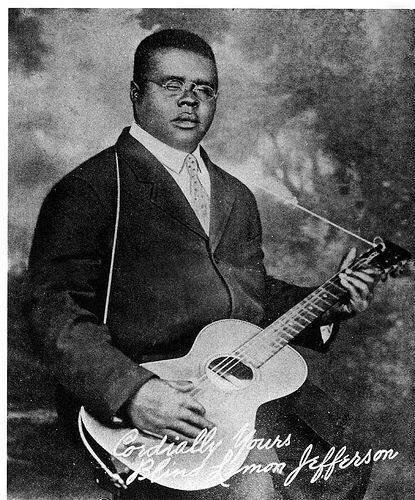
Blind Lemon Jefferson

It all begins with Blind Lemon Jefferson. Well, kind of. Blind Lemon was just one of the many ultra-talented blind blues musicians who inspired the eventual creation of rock n’ roll, but he developed “Matchbox” because he was inspired by a lyric in a Ma Rainey song. Blind Lemon, who has been called the Father of Texas Blues, was inspired by Ma Rainey – “The Mother of the Blues.” The blues ancestry works much like mythology, it seems. Blind Lemon and Ma Rainey inspired Robert Johnson, Howlin’ Wolf, and many, many others.

In Ma Rainey’s 1924 record “Lost Wandering Blues,” she sings, “Lord, I’m standing here wondering, Will a matchbox hold my clothes. I’ve got a sun to beat, I’ll be farther down the road.” In a pre-sampling example of sampling, Blind Lemon took that lyric and wrote, “I’m sittin’ here wonderin’ would a matchbox hold my clothes.
I ain’t got so many matches but I got so far to go.” Quite similar, indeed. Blind Lemon’s version of the lyric became more popular, but credit must be given to Ma Rainey as well.

There is Blind Lemon’s high croon and traditional Texas acoustic blues guitar. Gosh, pre-rock n’ roll blues is just awesome, isn’t it? This song was recorded several more times through the 30s and 40s but to no true popularity, though it was through one of these covers that the song was reintroduced to the public.

Thirty years later, Carl Perkins’ father suggested he cover the song in a December, 1956 recording session. Perkins’ father, Buck, was a student of old country music, and several country musicians covered the Blind Lemon song in the 1930s and 40s. He only remembered a few lines of the song. Carl decided to try his luck, and the session pianist, Jerry Lee Lewis (not a bad session pianist!), played a boogie rhythm on the piano. Perkins transformed the song into fast-paced rockabilly…with completely different lyrics.

The line that Blind Lemon adopted from Ma Rainey is still there. It is the only similarity that remains. The song, which Blind Lemon made about a mean woman, became a about a poor boy a long way from home. Here is Carl Perkins performing the song with Johnny Cash and Eric Clapton because we can!

The Beatles, who were inspired by Perkins, had received a request to record a Perkins song, and in 1964 they recorded the song with Perkins himself standing by. Yes, he was invited to the session, and did jam with the band (just not on the track). Ringo was tasked with the vocal responsibilities, and he sang the song while playing his drum set.

From the mother to the father to Mr. Blue Suede Shoes to the greatest band of the 20th century. And to think, I’m sittin’ here wondering if a matchbox will hold my clothes.


Climbing Mt. Everest Cale

24 Aug

Everest Cale

Sometimes a band is just meant to be. Everest Cale is one of those bands. Composed of a group of college friends from South Carolina who journeyed north to the Big Apple, Everest Cale came together because of persistence and the joint desire to produce good music. The friends, Brett Treacy (vocals, guitar), Jeremy Kolmin (guitar) and Aaron Nystrup (bass), added drummer Nate Becker and keyboardist/vocalist  Ryan Roets, to round out the rock quintet. Since 2010, Everest Cale has played clean blues-inspired rock with 70’s inspired edginess and noticeable modern sentiments. On Sept. 4, they release their first EP Beast, and in anticipation of the release let’s take a listen to the band’s self-titled single.

The song begin’s with a softly-plucked guitar backing Treacy’s vocals. Treacy’s vocal has an intriguing quality to it. It is noticeably powerful, but it maintains a tenderness that is refreshing. It is recognizable, but original to Treacy. The progression of the song is smooth. One of the most attractive aspects of Everest Cale is that they play a refreshing blend of music that is skillful, organized, and precise. As the band demonstrates with the feedback and rock breakdown at the end of the song, they certainly know how to let loose and “rock out,” but they do that in a mature, unphased way. They are in charge of their music, and that is something that makes for an enjoyable listen.

Everest Cale plays their release show at Rockwood Music Hall, Stage 2 (New York) on Sept. 1. I am eager to listen to the rest of the EP.

You can keep track of the band by visiting their website and following them on Facebook and Twitter

UPDATE: Jacob Miller and East Side Drag

2 Jul

Jacob Miller – Busking in the Bluegrass

You may remember Jacob Miller from a post I did in October about his Sept. 2011 release Blue Ridge Ramble. You can read it here. Ah, yes, Jacob Miller, he is that awesome bluegrass throwback with the warm voice and plucked guitar that makes you want to sit on your porch on a warm summer day with a nice cold beer and listen as the music mixes with the soughing winds and constant crickets. Yeah, well, thanks for doing my job for me. I guess I’ll just pack up my keys and come back tomorrow!

Jacob Miller, now a 22-year-old country-blues-ragtime-folk singer/songwriter/guitarist based in Portland, OR, is currently busking his way through the Northwestern United States. Back on June 22, he checked in with me to alert me of his peripatetic ways and send me the link to his new eight-track album, East Side Drag, which he released with his four-person band, The Bridge City Crooners. Here is what he wrote 10 days ago:

“Right now I’m in Wisconsin, and leave tomorrow for Minneapolis. There for two days, Sunday we leave for Montana, then north to Alaska. Should be a good trek. I’m looking forward to it, and looking forward to playing a lot along the way.”

Miller is a true musicians’ musician. If I don’t accomplish anything else with this update (which will take a glimpse at a few tracks from his album in just a moment), I hope that you take that message with you. He plays music because he loves music. Miller has the voice and skill to create a unique brand of Indie/Folk that could become widespread in this climate. But that would still require him to conform to a different style of playing, and Miller is not giving up his style. Miller, much in the vein of The Wiyos, the Carolina Chocolate Drops, and the late Rory Gallagher, is keeping Bluegrass music in our ears. While Miller’s first release that I reviewed focused more on independent blues, East Side Drag is an ode to fast-paced, harmonica-driven bluegrass style. And, take it from me, if you are into this type of music you will enjoy it a lot. Wait, you don’t have to take it from me, you can just listen for yourself.

East Side Drag

I actually had an issue picking three songs to profile from the album. I wanted to choose more like all of them, but I limited myself to three, starting with the title track from the album, “East Side Drag.” The first 10 seconds of the song set the mood of the album exceptionally well. Maybe it’s the kazoo. A kazoo, a scraped washboard, a bluesy guitar riff and harmonica- tell me you are not feeling like you are outside with this true jug band. There is just something about this feel-good music that sponsors thoughts of relaxing by a lake down South. Miller carries the blues riff over the fast-paced bluegrass rhythm smoothly and if you are not tapping your feet right now there must be something wrong with you! Kudos to Ben Bailey – Washboard/hollerin’ and Kyle Neumann – Harmonica for creating all those fancy noises making you tap your feet.

Jacob Miller’s cover of “Hesitation Blues,” – traditional blues song special to me because the 60’s psych/folk band the Holy Modal Rounders did a cover where they mentioned the word psychedelic (psychodelic) for the first time in a song – is intimate and smooth. I use the word smooth to describe Miller’s music a lot, and the reason I do this is because it seems effortless (which it probably is). Miller sings the song with a fun, nasally croon that echoes the intention of the song’s original authors more than 100 years ago. The lyrics are malleable and the piece is perfectly constructed for others to manipulate. Miller’s cover is one of the better versions I have heard.

I want to include this last song, “Take it Back” for a few reasons. First, it features the vocals of Joy Pearson who does a wonderful job pairing with Miller. It was also recorded on June 5th, the day before Miller and Ben Bailey hit the rails. It’s a fun piece, bluesy and quick. Pearson has a quiver in her voice that I love and her brief solo at the end is impressive. Like any good blue song, it comes and it goes, and like that Miller hit the rails to play it again somewhere else. Keep doing what you are doing and doing it well!

Bhi Bhiman Can Make Any Music Lover Go Crazy (in a good way)

17 Apr

Bhi Bhi "is the" man

The English lexicon is immense. When I write reviews of artists I try to enlarge my discourse in a manner that is not grandiloquent. I hate repetition in adjectives and verbs, and I love experimenting with language. Yes this makes me a word nerd (a werd), but I embrace the title. The reason I begin this new artist profile with a statement on language is because I want to introduce you all to a great word related to the artist I am profiling. It is elysium. You can swap it out with Shangri-la, Zion, Canaan, Utopia, or, simply, Heaven. Let’s say your wandering around this network we like to call the internet and you come across a taste of elysium. Well, damn, you want to share whatever it is like wildfire (or perhaps keep it all to yourself – but I learned early that sharing is caring so here you all go). The little taste of music heaven is a Sri-Lankan-American folk/blues artist named Bhi Bhiman. And Mr. Bhiman can do this.

A lot of reality television shows – specifically one that has the creator of the piece as a judge – looks for the “Voice.” So what characterizes a voice? I think that the first necessity is for it to stop you in your tracks. You can be going a mile a minute trying to complete 20 different tasks, but, for at least the first time you listen to it, the voice forces you to drop what you are doing and just listen. It is quite heavenly in its relaxation properties. Consider it like a hegira. The “voice” contains a super-rich fullness that is whole and striking. It is clear and booming. The “voice” is very difficult to come by (only some truly have it). Good news for all of you. Bhi Bhiman has the “voice.”

Listen to the power. Listen to the vebratto. Listen to the soul. I am not overexaggerating the point. Bhiman takes “Crazy” and literally destroys the song. He picks it apart (similar to how Cee Lo sings it) and destroys its contents to the point that you don’t even hear the lyric anymore, you just hear him.

Okay, you are all saying. Sure. He can cover a great song. But this is Cee Lo. What about his original stuff? How does his voice work when you get him to perform some of his own songs? I’ve got some more good news.

Bhiman’s solo material is like what would happen if you combined the folky goodness of a David Bromberg/Tim Buckley with the southern soul of Otis Redding and then mixed in some good ol’fashioned early blues. Put all of that in a blender and turn the blender on puree. Ta Dah. Bhi Bhiman. His songs range from a humorous folk originality to sagacious note-shattering fosoblu (folk/soul/blues). Let’s start with the former.

Kimchee (kimchi) is a Korean fermented vegetable dish and Bhiman in “Kimchee Line” takes a pretty tradition blues riff and, well, sings about kimchi as if it is a vegetable train (sort of).

“Well I went up on the mountain
To see if I could fly
Went down to the sea, lord
And the sea was dry
So I picked a pickled pepper
From the Leader’s Tree
I got some prawn and oysters
For the Vitamin E

I’m on the kimchee line
Its radish time”

It is cheeky humor, a funny mix of traditional blues and a true eat your vegetables message. Bhiman is efficient on the acoustic guitar, lightly plucking the rhythm that guides the song. His voice clearly shines (like it does in all of his songs) and, don’t forget, it’s “cucumber time”

Included here is the full version of “Guttersnipe,” loaded with the excellent bass of Ben Tudor, moving percussion of Gabe Turow, and effective key-work by Sam Kassirer. The itenerant song features a simple chord progression that helps accentuate Bhiman’s croon. A guttersnipe is a street urchin (which Bhiman pays ode to in the song). The chorus of the song is just Bhiman demonstrating his fantastic chops to the listener. His drop down from his vocal limits back to his comfort zone is so difficult and done to such perfection. At around 4:15 the song darkens and you feel for the poor guttersnipe that Bhiman sings of. You feel the song and that is incredibly important to success. Bhiman is a modern troubador, a true “voice,” and one that you should keep an eye on for this point on.

Tour Dates:

Thursday 4/19 – Bowery Ballroom – New York City
Show @ 9PM sharp

Friday 5/4 – Oberlin Folk Festival – Oberlin, OH

Saturday 5/5 – Lincoln Hall – Chicago, IL
Show @ 8:30PM

Saturday 6/9 – The Independent – San Francisco, CA
Show @ 8PM

Sunday 6/17 – Clearwater Festival – Hudson, NY

More Information About Bhi:

Facebook

Twitter

Website

Got My Mojo Working – Muddy and Cole

17 Nov

Mojo Baby Yeah!

 
How weird is it that the last Austin Powers movie was released almost a decade ago? My mojo reference is dated. No, Austin Powers is still a fresh memory. Plus, he is perfect for this post.


“Got My Mojo Working” is a fast-paced, haromica-driven blues song popularized by the great Muddy Waters. His 1957 version of the song became the one that most people cite when they think of this prime example of fast blues. There is no denying it. Muddy’s smooth croon and hedge-like slick black hair make the song slippery and a little dirty. What made Waters’ version so popular was its skilled use of call-and-response and James Cotton’s “I’m better than everyone here” harmonica. It is so proficient it’s scary. But when people say that Muddy Waters created this song, they are mistaken. While he did manipulate elements of this famous blues hit to fit his mold (and this definitely contributed to its popularity), the song was written by Preston Foster and first recorded by Ann Cole in 1956.


Cole’s version is more jump blues than traditional blues. The doo-wop background singers, backing high-pitched guitar, horns, and Cole’s poppy voice contribute to this conclusion. That is not to say that this original version is not good. No, it is great. There were lawsuits (of course) between record companies – claiming that Muddy stole the song after hearing Cole perform it. Whatever, that stuff was settled and it is unimportant. There was, however, a humorous ruling by the court when another performer claimed that songwriter Preston Foster stole the concept of “mojo” from her. This was the ruling:
 
 “MOJO is a commonplace part of the rhetoric of the culture of a substantial portion of the American people. As a figure of speech, the concept of having, or not having, one’s MOJO working is not something in which any one person could assert originality, or establish a proprietary right.
 
Mojo should be shared by all. Now, here is to hoping that the Jets have their mojo working for their Thursday Night Matchup against the Broncos tonight! To sponsor this sentiment here are some more performers showing their mojo off.
 
   – I think I was at this show.