I wrote about this album a few months ago, and as you could probably tell, I absolutely loved it. Now I’m here to recognize it for being one of the best albums of the year*. Instead of just rehashing all the praise I have already given it, I was able to interview the group in order to give us a little insight into Ghost Cousin.
I would like to whisk us off to Sweden for a moment, where the artist behind our #6 top single of 2014 resides. Amason is a quintet comprised of busy musicians, almost all of them associated with other projects, including Dungen, Idiot Wind, and Miike Snow. They’ve pooled their talents for Amason’s debut EP, but “Duvan” is the first taste we’ve gotten of their upcoming album, Sky City.
This is what indie rock should be. The upbeat tempo drives you through the song, but the lead vocals and notable whoo-hoos from Amanda Bergman are gripping. I also am partial to lyrics that don’t make sense, which I think Amason delivers fairly well here. I get the sense that this is a song about a relationship (aren’t they all?), but specifics are beyond me. Well done.
Amason released an EP last year with five songs that have somehow placated their fan base until now. They released the tracklist for their upcoming LP, and the only duplicate tracks from the EP are “Älgen” and “Went to War,” so I am excited to hear the other 9 new tracks (not including “Duvan”). I have listened to “Duvan” at least 100 times, and I still love it; if the whole album holds up as well as that single does, then Amason may have a top album of 2015 on their hands. For now, though, “Duvan” will have to stick with being a top track of 2014.
Sometimes all it takes to have a hit song is a sing-along chorus. Everyone loves to sing along with all the woohoo’s in “Song 2,” those na’s in “Hey Jude” (for far too long), and the hey ya’s in, well, “Hey Ya,” and because we can’t get them out of our heads, they become hits, then classics. Looks like Colony House has taken notice with their newest van jamming rendition of their hit single “Silhouettes.”
The studio version of this song is like hearing tinny Young the Giant; the vocals are dripping with reverb and the cute, infatuated lyrics all come together to form a sunny indie pop tune. A great summer song, but seemingly forgettable. But in the van it all changes- they strip away the exact production, add a hiccuping drum machine and kick up that quivering falsetto on those killer whoo-oo’s. We are all driving down the road, down the road in that van with you, hooting like adorable owls.
I have to admit though, their focused expressions do make the van version a personal experience. I loved watching their excited faces, especially when they held eye contact to time the final refrain. Colony House ends up matching the adorable nature of their own song with their body language. “Silhouettes” is on their debut full-length release, When I Was Younger, which is out now. Visit their website for more information.
Critically acclaimed debuts can often be a curse for a band. Plenty of bands have combusted under the pressure to repeat it – see the Stone Roses, the Klaxons, the Las and dozens others. However if there was ever a band that argued early success needn’t be a burden, it was the Arctic Monkeys, and AM is the conclusive proof.
As the title suggests, AM is stripped-down, back to basics, but the band have come so far in the last eight years it still sounds like nothing they’ve done before. It’s traditional rock but with a glossy veneer of hubris. Don’t mistake the anachronistic titles for dumbing down – this is just the band feeling comfortable in their own skin.
Gone is almost everything you might associate with their award-winning debut. The jangly indie guitar riffs have been replaced by muscular, R’n’B tinged tunes. The Sheffield quartets have truly embraced American sounds. This is mostly thanks to ‘R U Mine?’, a one-off song they released last year that the band liked so much they continued to mine the sonic space it had unearthed, and it now feels like an integral part of the album.
The social commentary that defined their first album has also mutated into richer lovelorn poetry. One of the highlights comes early in ‘Do I Wanna Know?’ as Alex wonders ‘if your heart’s still open and if so what time it shuts?’ It’s not tied to a specific place or time, but instead evokes many different shades of love, whether it’s drunk, desperate or just dumb.
In ‘I Wanna Be Yours’ Alex even adapts words from poet John Cooper Clarke. The fact they sound like his own shows off his strength not just as a lyricist but as a song writer.
Thereare almost too many highlights too mention.Album opener ‘Do I Wanna Know?’ sounds like ‘R U Mine’s’ evil twin, filled with alcohol-induced swagger, while ‘Why Do You Only Call Me When I’m High?’, is one of the funniest songs they’ve ever produced. ‘Number One Party Anthem’ is a huge misnomer; you could more imagine Alex crooning it in a smoky jazz bar. I’ve managed to get the end without mentioning the best song, ‘Abarbella’ with its flickering riffs and vivid desert poetry.
It’s impossible to retrap lightening in a bottle but Arctic Monkeys have managed to make something different and just as good. Purists who are still waiting for more stories about taxi ranks need not listen but everyone else is going to love AM. If Alex Turner has only recently grown into his role as a rockstar, this is the soundtrack to his new life.
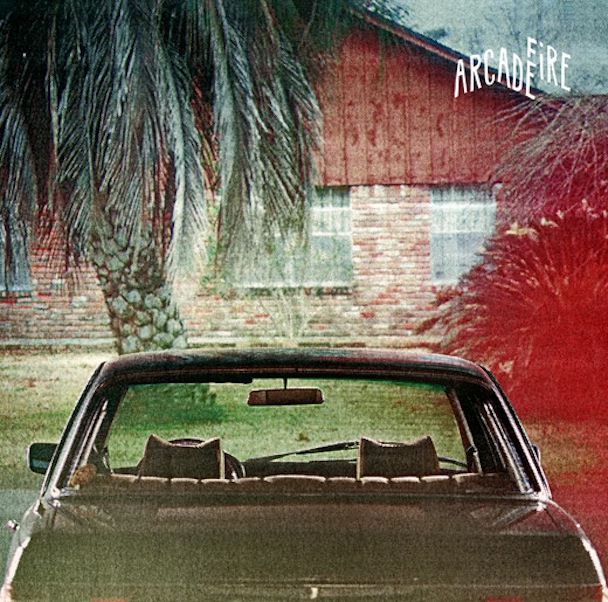
It was announced this week that Arcade Fire have completed work on their forth albums. Details are sadly short on the ground, but it will be the follow-up to The Suburbs, one of the most critically-acclaimed and sadly forgotten albums of the last few years.
Whereas their classic 2004 album Funeral was a bombastic ode to childhood, the Suburbs saw the band looking back at their own adolescence through the prism of the places where members Win and Will Butler grew up, the suburbs of Texas. The first few songs capture the uncertainty and boredom of being a teenager in a world ruled by adults, while still managing to create a radio hit in Ready to Start. There’s a heavy sense of nostalgia weighing down on them, a childhood that’s been irreversibly lost.
From there, the album skips on a couple of years. The children – friends, siblings, lovers? – of the early chapters have grown up and are returning home after ‘the markets crashed’ in 2008. The only thing worse than yearning for your youth is having your illusions about it shattered, but that’s what happens. The climax as the album is a two part song called Sprawl. The first one is a mournful, barely musical dirge in which the protagonist attempts to find his old home in the dark and fails, while in the second Win Butler’s wife Régine Chassagne gets to display her vocal talents in an ABBA-inspired track about the daily 9-5 grinding you down. The contrast beautifully sums up the album’s complex and mature themes.
There are a dozen more things I could rave about, from the constant threat of an apocalyptic war that hangs over the early tracks, the clever symbolism of light and darkness throughout or the way it manages to make big statements without ever coming off as pretentious. After the emotionally barren music that we are so often offered nowadays, an album that asks so many personal questions about you comes as a shock.
Full disclosure – it may not be the genre-defining masterpiece I imagine it to be. It may just be the tales of leaving your childhood home struck a chord with me at a time when I was beginning university, leaving a permanent imprint, but that’s exactly what good music should do. It should say the things you can’t and explain the world to you.





 The Music Court