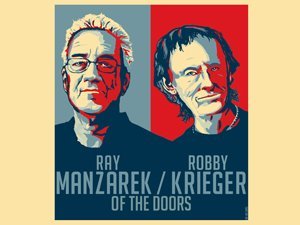
During the brief car ride from my house to Westbury Music Theater (NYCB Theater at Westbury — whatever they are calling the once Westbury Music Fair these days), my father and I laughed about a surprising tidbit about the Doors that we learned from my brother. In April of 1968, the LA-based rock band – one of the most celebrated bands to come out of the era of peace and love – played the Westbury Music Fair. The Doors, at full-strength, played a small venue a short drive from my house (a brisk 10 minute walk from my gym). We laughed because of how odd such a story seemed. The Doors playing Westbury Music Fair at the height of their success?
The Doors did in fact grace the tent-like circular stage of the Westbury Music Fair on Friday, April 19, 1968. 3,000 upholstered seats of the brand new theater (which was an actual tent until 1966). And, for reasons unbeknown to anyone but the men themselves, they played two shows. One, a poorly attended early bill…on Friday afternoon. The second show was at night and Jim Morrison wasn’t having any of it.
For an account of the concert I want to turn to a piece I read online which I think perfectly describes the mercurial Morrison and the contradictory apoplectic and apathetic show that he put on for the New York crowd.
“Morrison wasn’t on stage when the music began. Suddenly there was a confrontation on one of the downhill aisles leading to the stage. He stumbled down the steps, entangling his black leather and a mass of tangled hair with the offstage darkness. He stopped to pose, and a flash of light caught him trying to regain his balance. The taunts began immediately. He responded with force indifference or a threat of random violence. The other Doors were in other rooms. They played on, almost oblivious to his ranting and raving. A familiar riff would begin, the audience would briefly come to attention, and he would leave the spotlight to inflict his boredom on them. He would fall into shadows searching for worthy opponents. There were glimpses of physical confrontations: crewcutted jocks protecting their interested girlfriends from his suggestions. Morrison’s fist shooting blindly in the direction of obscene threats as a fat security guard grabs at him with a pathetic attempt to control the situation. Morrison embraces the guard and tries to pull him towards the stage while delivering a passionate plea for weight loss. The guard frees himself, runs up the aisle to derisive laughter, dropping his hat. Morrison tries to wear the hat but it is too small and suddenly he is disgusted with the whole scene and lets out a frenzied scream. Silence in the theater for the moment. The audience stared as though it was a horrible car crash where the spirit was maimed and the blood ran into the gutter of the soul. Morrison twitched in some kind of death throes. The concert ended abruptly. Morrison howled but it was not with ecstasy. It was more Ginsberg than Blake. The lights came up before the band could walk back up the aisles and the audience booed. Morrison stood still listening. I stared so that my eyes would forever cover him. Some people were leaving, others still booing, a few watched him as intensely as I did. Then in this haphazard atmosphere he threw back his head and began to chant and dance in place like some possessed American Indian brave consecrating a sacred land, cleaning the abuse and disdain with singular belief so powerful that shivers ran through me. And my heart froze with undeniable blessing. A girl ran at him with scissors flashing to cut his hair and he disappeared into a circle of anonymous flesh carried him away.” (David Dalton. Mr. Mojo Risin’. New York: St. Martins Press, 1991)
It sounds more like an orgy than a rock concert. If you need any evidence of Morrison’s, for lack of a better word, showmanship this is your proof. Screaming vocals, blind punches, random hugs, sarcastic remarks, demonic dancing. The works. Don’t you love it? A little more than three years later Morrison died of a drug overdose. But he certainly left his mark on the Westbury Music Fair. And, on Friday, Nov. 4, Doors’ keyboardist Ray Manzarek and guitarist Robby Krieger came back to the Westbury Music Theater.
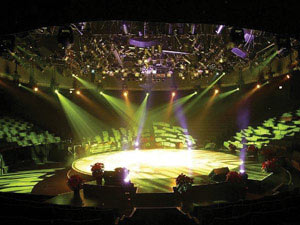
- Westbury Music Theater
It is important to get one important point out of the way prior to my review of the concert. Ray Manzarek and Robby Krieger are perpetually underrated at their respective instruments. The Doors would have not been the Doors if they did not have these musicians (and drummer John Densmore – who also was an essential part of the band’s success). While Morrison was the glue that made everything stick together, there would have been no Doors without the skill and inspiration of his band-mates. He would have been the first to tell you that.
The concert began 30 minutes late (a staple of Westbury Music Theater concerts – always waiting for the last person to get a drink and settle in). The lights dimmed and Manzarek and Krieger came on stage with their band, and a faux-Jim Morrison named Dave Brock (the leadman of The Doors cover band Wild Child – and a decent Morrison look-alike). Manzarek spoke first.
“We played here before. 43 years ago!”
The crowd erupted. I looked at my dad and we both gave each other the same wide-eyed look. We were wondering if they would mention their past performance.
“And, we are going to play the same set list we played last time we were here!”
Manzarek spoke with vigor, his voice loud enough that the microphone wasn’t even necessary. Krieger and him laughed. The crowd was flabbergasted. How cool! The same set list? What an exciting opportunity to re-live that date in time. Brock stood up to the microphone and Krieger struck his guitar.
“There’s blood in the streets it’s up to my ankles,” the crowd yelled, making Brock’s microphone-aided croon inaudible with their own rendition of one of the most famous opening lines in Doors’ history. On the following line Brock’s vocal found its way over the electric crowd’s communal voice and, wow. I closed my eyes and imagined 1968 (well a more sober performance). Impressively, Brock’s performance echoed Morrison’s vocal mannerisms. A truly accurate copy. He stepped back from the microphone and (in a move that he would do several times during the night) allowed a youthful Manzarek (72 years old) and Krieger (65 years old) to occupy the spotlight. It was their show. That was tasteful. When I opened my eyes (and was transported back to 2011) I realized that despite the fact that it was 2011 and Jim Morrison was dead and John Densmore was not performing with the band any longer, this incarnation of the Doors was perfectly suitable. The performances oozed with power and talent, a beautiful mixture of crowd excitement and band appreciation. Everyone was having a good time (especially the men themselves).
The band trucked through hit after hit – “Roadhouse Blues,” “When the Music’s Over,” “Alabama Song” – all excellent performances that the crowd sapped up with comfort.
Before I talk about the performance of the night (and one of the better performances I have ever seen at a concert) I’d like to briefly discuss “Soul Kitchen” a lesser-known Doors song that, before played, Krieger remarked he didn’t think they had played as a band in…43 years.
This is an excellent, underrated Doors song that was a pleasure to hear. The repetitive bass-line was carried well by Phil Chen and drums by Ty Dennis. The rendition of “Soul Kitchen” was memorable because of the flavor that the band put into the song. This made the rarer Doors’ song accessible to some of the crowd that may have been unfamiliar with the song (even though it did seem like the crowd knew every lyric of every song). This, obviously, was no issue with “Light My Fire.”
Think of everything you love about The Doors – the energy, sexiness, ruthlessness, originality, togetherness – and throw it into a pot of boiling liveliness and love. Let that boil for around a 20-minute epic performance of “Light My Fire” that neared mystical levels and you have a great performance. Brock’s voice was spot-on, his Morrison-like yell satisfactory. Chen and Dennis both sustained some small solos. Hell, even Ray Manzarek’s brother Rick was on stage adding to the percussion. Manzarek’s keyboard was perfect. No other word. Midway through the performance, Manzarek stood up from his stool, kicked it over, and swiftly put his right foot on the keyboard! 72 years old, my ass. Krieger responded with shredding guitar solos (several of them). Near the end of the song the entire band got together on the stage and, in a Rockette’s line, moved back and forth like family. And, for Manzarek and Krieger this is what performing is to them now in 2011. It’s family. To quote radio-legend Cousin Brucie, the fans are cousins.1968 or 2011 – Manzarek and Krieger are still rocking – both vivacious as ever showing no signs of slowing down.
P.S
On the subject of the Doors, did you see Jimmy Fallon’s Jim Morrison impression his late-night show the other day. Many don’t realize that Fallon is true comedian with an aptness for impressions. His accuracy is scary.
Check it out:



 The Music Court