The Fall of Troy – Phantom on the Horizon

10 Jul

My head was jerking violently, my eyes following a picture of a musical note scrawled onto a piece of paper hanging from piano wire. It was making me dance for my life, the snipers and high powered machine guns waiting for just a single misstep. As the subconsciously ritual unbuckling and buckling of seatbelts continued, I tried to calm myself without the help of my heart which had already sunk out of reach. Bloody smiles and mangled cars watched as the powerful magic I attempted to wield spun out of control. I hit the brakes but it was too late, my mind had strayed too far from the fine line. I had been thrown into the mercy of the other half

**********************************

Uhh… hi everyone. Today we will be exploring a little bit of the darker side of psychedelia. I’ll start with a little bit of history. Psychedelic rock was a main influence in what today is known as heavy metal. The genre is splintered into many sub-categories, such as death metal, thrash metal or even punk. There are countless forms of metal these days, but the one thing that is common among most of them is that the psychedelia has been phased out.

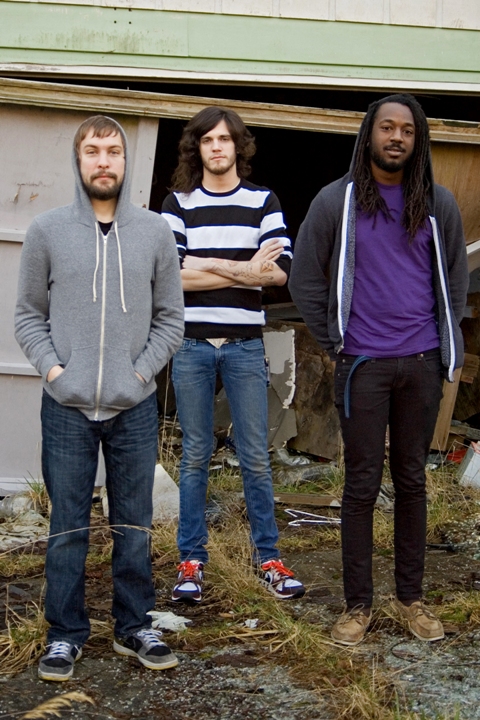
The band I bring to you today is the Fall of Troy. They are a hardcore band from Washington state that is also guilty of phasing out pyschedelia, up until recently anyway. One of their more recent EP’s, Phantom on the Horizon, is one of the best examples of heavy music implementing psychedelic elements out there. It does this, however, in a much different and darker manner than most traditional psychedelic bands would. This naturally suits a hardcore band.

If I had to accurately apply a genre to the EP, it could only be a psychedelic post-hardcore rock-opera. It consists of five songs, or ‘chapters’, and spans the length of a nightmarish and most-likely magic induced story about a Spanish galleon which encounters a ghostship from another dimension. It features amazing lyrics and is highly over-produced compared to the band’s other, more-raw albums, giving it almost this truly genuine hellish feeling.

Chapter II: A Strange Conversation opens with an extremely powerful introduction. The drums hammer away complex rhythms with precision while the guitar shreds away only building in intricacy as time passes. The combined sound creates that intense metal feeling right up until the beat skips and begins to stagger in a more hardcore manner in my opinion.

The vocals come in clear along with ridiculous guitar lines. The only thing that can make listening to this band better is knowing that both the singer and the lead guitarist are the same person. That means whenever you hear jaw-dropping shredding and raging screams, the source is the same entity.

Yes I did say screams. If that is cause for some alarm then let me try to ease you. I like to consider this song the friendliest introduction to screaming possible. They really aren’t that bad on this album in general, especially when compared to the rest of the band’s music, and they fit perfectly with the theme of the story.

What I love in particular about this song is that the screams truncate extremely clear and downright good lyrics, eventually leading into very powerful opera-esque wailing vocals which do justice to the singer’s wide range. In case you are wondering who is this extremely talented musician, his name Thomas Erak, a quickly blossoming guitar legend.

The song ends on a very slow and calm note, putting the post into post-hardcore. The music is one of a kind, and almost even more importantly, the feeling it conveys is a brand of overwhelming psychedelic insanity that bands in the 60’s only dared approach with a thick wall of dry-humor.

Chapter IV: Enter the Black Demon is the other song on the EP which I need to share. As kind of the musical apex, it opens with a flurry guitar notes and drum beats which melt into one another as if it all were riding on the edge of a massive volcanic explosion. A long howl does very nicely at indicating the mood at the current point in the story, and a second singer is implemented to represent the ‘black demon’.

The main vocalist and protagonist of the story fights for his sanity here with his confrontation with ‘black demon’ “Bang Bang Bang Bang, the thoughts in your head taking hold.” The representation of madness seen here is dealt with a passion that demands respect. A short heavy screaming part (MURDER) segues into a light and upbeat bridge. “Explanations turn to Explanations which turn to Explorations.” It gears you for a intense guitar solo which builds heavily into an abrupt and again peaceful ending.

The contrast between the endings and the rest of the songs on this album make for beautiful metaphors, kind of like sailing on the seas which one day are calm, the next stormy.

This sort of epic EP, with a length of only 37 minutes, is best enjoyed in a full sitting. Only then will you be able to truly appreciate a masterpiece of this sort of mood, which is actually very new to musical scene and is very psychedelic in nature. Just the screams alone convey a feeling which is truly hard to replicate any other way and even show a definite level of commitment to the music based on the negative effects of screaming. The sheer range of emotions in this EP creates an openness of interpretation which allows any listener enjoy it like a custom tailored movie experience.

Side- Note: If you are someone who refuses to listen to this because of the screaming then keep this in mind. Phantom on the Horizon is actually a remake of the band’s much earlier Ghostship demos. The demos were essentially the same songs, minus chapter three, much shorter, and a lot more raw. There is even a debate on the internet about which version is better, with supporters of the latter saying that the new release is way too tame for their tastes. In my opinion both are great in their own regards, and if you are willing to compare the two I will link the original version of chapter four down below. Just remember, screamed vocals are quite the… acquired taste… and please, for the love of god, don’t automatically associate them with ‘screamo’.

>&)

-oko

P.S. RRRROOOOOOOOOOOOAAAAAAAAAAAAAARRRRRRRR

Madonna as Number One Artist on Rolling Stone’s Queens of Pop list

9 Jul

Hi all,

I was recently perusing through the relentless abyss of internet musical commentary when I decided to check out one of the ultimate staples in entertainment journalism, Rolling Stone. The website posted a super neato ranking of the modern queens of pop, with selection determined by readers.

First of all, I want to shake the hand of whoever is responsible for placing Sir Elton John as number 9 on the list, comfortably one spot away from Mariah Carey at number 10. Kudos to you good madame(s) or sir(s), kudos to you.

Ultimately, the content of this list, in my opinion, was pretty solid . The sequencing was a little odd though-Aretha Franklin was at 6…Britney Spears at number 3. But this can be chalked  up to the fact that the list was derived from a reader’s poll, in which case reply variance can always produce some weird twists.

Overall Queen Madge is well deserving of the number one spot. Yeah she may not be a vocalist in the same league of Aretha, but the lady pretty much invented, or at least greatly defined, modern pop as we know it today.  As stated by Rolling Stone, “Sure, her last few albums didn’t match up to the classics. Nobody cares. She’s Madonna”. They are certainly right. At this point, Madonna could  maitntain her iconic status even while  fading into obscurity at  Bora Bora.

Madonna on a horse, just because.

Madonna is currently working on a much anticipated 12th album, proof that living legends can indeed maintain a perpetual cultural relevance.

Fourth of July Trivia Answers

8 Jul

YEAH!!! America! - Wait, What?

Hopefully you all enjoyed your Fourth of July weekend. Now that we are all back to being fully ensconced in the drudgery of life without reckless barbecues and fireworks play, I think it is a good time to reveal the answers to the Fourth of July Music Trivia Game. If you still want to play, go and answer these questions prior to reading this post Unfortunately, I cannot crown a winner this week because no one commented on the post with their name and answers. Perhaps I will create a better way to crown the winners in the future without making individuals comment on the post. I can still post up the answers and tell you all how you did. Let me commend everyone who played for all getting the first question correct. The national anthem did indeed come from a British Drinking Song (the one below to be exact).

Credit to the Georgia Tech Glee Club for the rendition. While there was a 100 percent success rate on the first question, things did not go as well for the other three questions. Let’s answer them one by one.

2.) I want to know what American musician gave Randy California his stage name?

The popular choice was Jim Morrison. It does make sense in both the geographical and time aspects. California received his nickname in 1966 and the Doors formed in 1965. But despite the links, Morrison did not give Randy his nickname. Jimi Hendrix, who met Randy at a guitar store in NYC, gave him the nickname of California when he joined Hendrix’s short-lived 1966 band, The Blue Flames. The band, which also featured bassist Randy Palmer, had a slight same-name problem that Hendrix solved by giving each Randy a nickname based by where they came from. Palmer became Randy Texas and Randy Wolfe became Randy California. Congrats to those who got this question correct

3.) Jimmy Page is often cited as the originator of using a violin bow on a guitar, but this is incorrect information. Who was the true FIRST guitarist to popularize this practice?

I admit, this was a bit of a trick question. But I’m glad I asked it, because it just exposes the unfortunate anonymity of the guitarist who started this inventive trend and also still serves as a great guitarist. Eddie Phillips did not receive a single vote, but he is the correct answer. Jimmy Page was inspired to strike the guitar with a violin bow by David Lindley, a multi-instrumentalist who did indeed experiment with this practice, but did so after Eddie Phillips started. There is the slight catch. Phillips first played the guitar with a violin bow in his pre-Creation band The Mark Four. With the Creation, Phillips mastered the playing style and used it in several popular recordings.

4.) Newman vocalist/keyboardist John “Speedy” Keen worked as a chauffeur for a famous British band who’s guitarist thanked Keen by creating the band around him to showcase his work. What was that band?

Most votes went to the Rolling Stones, but “Speedy” Keen was not driving around Mick and Keith. Instead, Keen chauffeured Pete, Roger, John and a probably intoxicated Keith Moon. Townshend, a good ear for talent, gave Keen the opportunity and man did they strike gold with “Something in the Air.” Enjoy!

New Coldplay Single – “Moving to Mars”

7 Jul

When you mention Coldplay you often get an eye-roll or a noticeable disapproving grunt. I know I have mentioned this phenomenon before on the blog and, while it seems that I always preface a Coldplay-related post with a disclaimer, I am generally bemused by Coldplay’s treatment. Yes, I do understand, that they are laughing all the way to the bank, and perhaps their mainstream economically succesful status may be a drawback for some, but Coldplay definitely odes not deserve the rap it gets. Their new single “Moving to Mars,” which appears on a three-song EP foreshadowing their new studio album’s Fall release, demonstrates the continuing maturation of this piano pop/rock juggernaut.

Chris Martin has an excellent voice with broad range. “Moving to Mars” is a soft piano piece that represents sincere simplicity and portrays Martin’s range. The melody is ingenuous and not at all gaudy (a label that some of Coldplay’s songs receive). The song is inventive and this is much appreciated. It’s keyboard driven filler portions alludes to some prog-rock conventions of the 1970s. Also, for a plus-four minute song, it moves quickly. Well done.

John McVie – From the Bluesbreakers to The Chain

5 Jul

John McVie? Isn’t he the bassist from Fleetwood Mac? Absolutely. But he wasn’t always in Fleetwood Mac. Welcome John McVie into this week’s installment of “Same Artist, Different Place.”

McVie got his start by playing in High School with a cover band. This has become an almost hackneyed opening to all musician stories, but High School cover bands are truly the way that most famous musicians get started. So the lesson here is to seek out the talented musicians in your High School (like McVie) and latch on to their band. Can’t play an instrument? No matter, be their manager or something. Let’s get back to reality.

McVie played music from the Shadows with his band Krewsaders until leaving school at 17 for tax inspector training. Music, at that time, became a side hobby until bassist Cliff Barton turned down a part in a new Chicago-blues style band called John Mayall and the Bluesbreakers and suggested that Mayall give McVie an audition. Mayall listened and was impressed with McVie. So, Mcvie, with no formal training in music, was accepted into the Bluesbreakers. Mayall gave him albums from B.B. King and other blues musicians to study.

Before Fleetwood Mac, there was the Bluesbreakers, who would later become known as a talented platform band, where English musicians went before becoming famous with other acts (kind of like The Yardbirds). Musicians like Eric Clapton, Jack Bruce, Mick Taylor, “Sugarcane” Harris, Andy Fraser and Aynsley Dunbar played with the band. The band was exceptionally talented and it sustained itself with tremendously talented musicians.

After Clapton and Bruce left the Bluesbreakers (they would later form Cream), Mayall added guitarist Peter Green in 1966 and soon after added drummer Mick Fleetwood. I bet you see where this is going. McVie developed a great relationship with Green and Fleetwood and after Green was replaced by Mick Taylor he started a new band which he called Fleetwood Mac, after his beloved rhythm section of Fleetwood and McVie. It didn’t take too much convincing to get Fleetwood over to the new band and after McVie became dissatisfied with Bluesbreaker’s move towards Jazz he joined the new band in 1967.

The rest is history.

Here is McVie playing “All Your Love” with the Bluesbreakers (Eric Clapton on guitar).