While Indie singer-songwriter extraordinaire Miko de Leon delicately croons for his listeners to “slow it down” in the single “On Your Mark,” this proves quite difficult when you do not want the infectious rhythm to end! But at least when the song ends you can always hit repeat, which I’ve done several times in the last hour. This is the case for most of the music released by de Leon’s band Miko & The Musket. The 7-piece Indie band exceeds what one expects from most Indie bands, for instead of falling into a consistent sound, the band provides diverse instrumentation and vocals that provide a diversity of sounds much like a variegated strobe light in a dark room. There is such richness in the multifaceted vocals, and this is only accentuated by the folk/funk/pop rhythms evident in each piece. Thus, in a sense, Miko & The Musket is genre less, a fascinating combination of a slew of sounds and rhythms that form a pleasant amalgamation of sound. This is perhaps best portrayed by the single mentioned above, “On Your Mark.”
“On Your Mark,” combines a fresh funky rhythm with creative folk harmonies. The song begins with an Americana funk sound much like that of Rusted Root. The percussion almost takes on a World music quality, and the band seems to ride the wave of many different types of rhythm. de Leon’s voice is like whipped cream: light, fully, and tasty. He blends well with his supporting vocalists – Molly McAdoo and Lannon Killea – who both provide fun fills – much like UK Indie folk. There are just so many catchy qualities of this piece, and it is difficult to not sing along or at least bop your head to the rhythm. The song falls off towards the end and quite literally slows itself down, but, much like the style of choral pop bands, rises back up into a culmination of sound and instrumentation.
Great piece by an up-and-coming Indie powerhouse in New York. Check out more about the band on its website, Facebook, and Twitter.
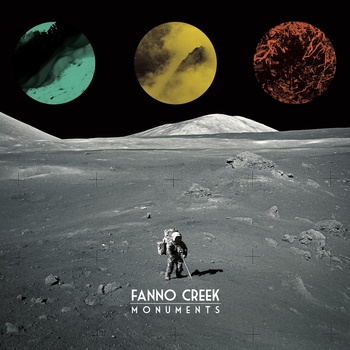
One of the definitions of the word monument is “something venerated for its enduring significance.” It is also the title of Portland Indie-Rock staple Fanno Creek’s new album, and one listen to the band’s music proves the definition apt. A beloved sing-along band in the city of roses, Fanno Creek is ready to spread its arms and fly over the musical waves of all 50 states and beyond … and maybe soon become a monument. While I am admittedly overwhelmingly kind on the Music Court, I reserve the 50-state praise for the bands I feel are ready to spread rapidly, and this trio consisting of Quinn Mulligan, Evan Hailstone, Dane Brist is more than ready.
Bands that depend on harmonies need to maintain a closeness that other bands may get away with lacking. Fellow Northwestern harmony-kings Fleet Foxes formed by way of two long-time friends. Fanno Creek shares a similar tale. Evan Hailstone and Quinn Mulligan knew each other in diapers and started making music together in their mid-teens. In college, the duo expanded to include drummer Dane Brist, and after several incarnations formed Fanno Creek in 2009. Since then, the band has toured the local circuit, forming a loyal following of music lovers who know good tunes when they hear them. With Monuments, it is time that the word spread.
“On My Way” is a quintessential example of why I cannot stop listening to Fanno Creek. The song starts with an infectious harmony pasted over a pounding singular drum. The vocals are intricate. The incipient harmony leads into a pure layered vocal over a gospel clap, an element slightly unconventional to Indie/folk music but quite refreshing and unique. Brist’s drum is not far behind, and it crashes into a culmination of symphonic sounds and this majesty diapason of harmonies and electronics. It is a wave of sound. It’s just really damn impressive!
“Trilithon” is my second favorite track on the album, and while ostensibly it expresses similar qualities to “On My Way,” the reverberating drum and swooning harmonies (and soft vocal howls) almost sound Beach Boys-esque, and this adds a whole new element to the music.
So … you know what to do; spread the word of Fanno Creek to all of your friends!
Check out the rest of the album at Fanno Creek’s Bandcamp. You can follow the band on its Facebook and Twitter.
In the liner notes of his summer 2013 EP, Adam Brock writes “Everyone finds solace in song, regardless of age and circumstance. I hope this music serves that purpose for some.” Keen statement from the young musician from Oregon. Brock, a multi-instrumentalist with a sensational ear for melody, is the best kept secret in the Pacific Northwest. Heck, he may be the best kept secret along the entire Western coastline. With a whispery vocal that he skillfully layers to the euphonious instruments that he plays, Brock is the sweetest sound in Indie that you are not listening to … but will be soon.
I know I lay down a lot of praise on this blog, but I know when I should particularly highlight an artist. Brock is that artist. He is also humble and unassuming, which is a major plus in my eyes. This is a dude who not only knows music but also puts time and effort into perfecting the intricacies of his tunes. His small selection of music from last year was quite impressive, and it is all available on his Bandcamp for free, so I totally suggest checking it out.
“Poplar Trees” is from his 3-track release in January of last year. The first 30 seconds are a bit deceiving because Brock immediately provides this mystical vocal track that sounds like other Pacific Northwest bands like Fleet Foxes. This, of course, is not a bad thing, for I am a bigger fan of folk harmonies than most, but it is not Brock’s predominant sound. The consequent electric percussion and keys is more of Brock’s scene, and oh my does he sound like a young Death Cab for Cutie, does he not? The early 2000s Indie Pop bleeds from the song. Then, the bottom falls out of it and the song is carried by a halcyon picked guitar and Brock’s sweet voice. It is as the ultimate blend, and it is done masterfully.
“Headphones,” released in June, also maintains that Ben Gibbard sound (almost a minimalistic Postal Service). There is also some Bright Eyes and the Shins thrown in for good measure. Brock knows what he is doing. In this piece he even adds a Velvet Underground-like string section (cello, viola, violin). Honestly (and why would I lie), Brock’s music is excellent. He displays ability far beyond his years. There is only one question I can ask: why is he not touring the U.S.? Let’s make Adam Brock more known.
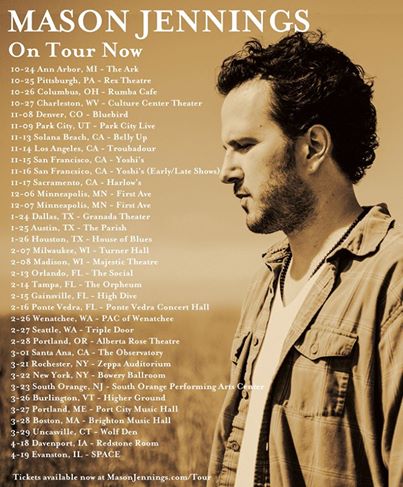
The first song I ever heard from Mason Jennings was “Ballad of Paul and Sheila” off of Jennings’ fourth album Use Your Voice released in 2004. The incipient picked chord progression piqued my interest and Jennings’ commanding and delicate croon hooked me. It was only a bit later that I learned that the song was dedicated to Minnesota senator Paul Wellstone and his wife Sheila who died in a plane crash in 2002 (Wellstone was a strong advocate for peace and social advocacy and was the only senator facing reelection to vote against the Iraq war) – I was 14 and not that up on politics at the time! The simplicity of the memorial lyric stuck me to the music of Mason Jennings for good, and 10 years later Jennings is still creating exceptional acoustic music and flying under the radar when he should most definitely be soaring among the most renowned folk artists today.
Aside from “Ballad of Paul and Sheila” my favorite Jennings song is “Jackson Square,” which is perhaps Jennings finest moment as a sad raconteur. The song is one of the finest examples of a lyrical story. You can check out the lyrics by following that link, and I also urge you to listen to the song.
I tell you all of this because Ritter released Always Been back in November of 2013, and for me it was his best release since In The Ever, which he released back in 2008. Always Been put him in double digits for albums with original content (not including The Flood), and is demonstrative of an artist who just continues to create multifarious content that still harbors the impressive emotional appeal, as if each song is a track created just for the listener. Good artists are able to create this feeling for a few songs, but great artists like Mason Jennings do this consistently, and Jennings has done it since the late 90s. Hence why I am always shocked that more listeners are not aware of his aptitude.
Jennings was born in the Aloha state but moved with his family to Pittsburgh at an early age (quite the unfortunate move if you ask me). He learned to play the guitar, dropped out of High School, and toured the U.S. gathering stories and experiences that he would use to script his first foray into music. After settling in Minnesota to produce music, Jennings started to churn out album after album of songs rife with political activism, first-person narratives, and emotional tributes. While narrowing in on his identity, his music became tighter. Now, nearing 20 years as an artist, Jennings is masterful. His effervescent songs can liven up any room and his minimalistic singer/songwriter pieces carry an innocence and ardor that affects listeners.
Always Been is most similar to Bone Clouds, Jennings most potent release. The song are riveting and each one has a distinct Jennings flavor that captures the attention of the listener. Jennings has been working on an expanded, fuller sound that is recognizable with this release. While he still is able to garner the solo drawn, his other tracks maintain a jauntiness that complements his storyteller vocal. A great example of this is “Wilderness.”
“Dreaming” is a more traditional Ritter track, although it is almost like a folk lullaby. Plus, tell me the falsetto “dreaming” in the second chorus isn’t just sweet. It’s impressive. The short piece is stripped down in this live recording (a little different than the studio version). Ultimately, although I hate the word, it is a nice song.
Check out the full album on Mason Jennings’ website and check him out on tour.
Frank Turner is no stranger to this whole music thing. His road to get to nowwas just a slight bit unconventional. You see, Turner’s first music love was Iron Maiden metal. Yes, the picture above does juxtapositional wonders: tattoos on his fingers hugging an acoustic guitar. His folk fervor came after his initial band, Million Dead – a post-hardcore effort with songs like “Murder and Create” and “Pornography for Cowards” – split up. After coming across Bruce Springsteen’s Nebraska, Turner had an apotheosis: fuse his hardcore roots with a punk-infused folk style and see what comes of it. Five albums later and fit with a full backing band, The Sleeping Souls, Turner has just reached the pinnacle of his solo career with his 2013 effort Tape Deck Heart, which coincidentally was inspired by another break up; this split was of the love variety.
Turner, of Meonstroke, Hampshire, has developed a unique style based on his illustrious and diverse career. It seems that when you blend hardcore and folk together, you get an esoteric form of punk. His music is laced with an acute acoustic vibe that maintains punk angst and power. Think Violent Femmes mixed with celtic punk mixed with Bob Dylan. It doesn’t seem to mesh, but Turner skillfully does it, and he does it particularly with the #4 song on our list – “Recovery.”
In 1962, Neil Sedaka and Howard Greenfield penned the song “Breaking Up is Hard to Do,” and this ditty concisely stated a fact of life. Breaking up is indeed hard to do. Turner wrote and recorded his new album after the collapse of a long-term relationship, and this adversity sparked some tremendous music. “Recovery” is not your usual break-up song, though. Turner’s lyric is jam-packed with candor and passion. In a sense, Turner, whose vocal is that of a strained raconteur, is pleading throughout the song, and the subject of his emotional petition is skillfully placed as the conclusion of the piece when he sings “Darling, sweet lover, won’t you help me to recover.”
Turner, in an ode to Dylan and other folk songs of the past, packs in so many words in each verse that the song plays like a short story. The music permits this lyrical burst. The Sleeping Souls help drive the piece, which is carried by a swinging piano and heavy percussion. The acoustic guitar glides with Turner’s busy vocal. Musically, the climax comes at around 2:15, when the Turner’s vocal falls out after the bridge in favor of a small piano solo and rising guitar. The strength of this song, though, is Turner’s masterful lyric.
Perhaps the strongest lyric is the full second verse.
“And I’ve been waking in the morning just like every other day
And just like every boring blues song I get swallowed by the pain
And so I fumble for your figure in the darkness just to make it go away.
But you’re not lying there any longer and I know that that’s my fault
So I’ve been pounding on the floor and I’ve been crawling up the walls
And I’ve been dipping in my darkness for serotonin boosters,
Cider and some kind of smelling salts.”
Fumbling for his ex-lover’s figure in a daze and then realizing that it was his fault that she is gone. Then following this pursuit by searching for anything (serotonin boosters, spiked cider, and smelling salts) to lift him up from the crippling depression he is feeling. Talk about truth, right? Turner does not want to paint an optimistic picture here. Before hitting the last chorus, where Turner sings of the long way to recovery, he croons, “Because I know you are a cynic but I think I can convince you. Yeah, cause broken people can get better if they really want to. Or at least that’s what I have to tell myself if I am hoping to survive!”
He, like most after break-ups, cannot shake the thought that perhaps if he changes he can convince his ex to come back. But, in honest fashion, he realizes that he is only telling this to himself to “survive.” He intertwines the metaphor of drowning into this piece, and that is a smart decision because while the listener drowns in the sound and words of this piece, Turner is quite literally drowning in his words, trying desperately to rise up into recovery but undergoing a song-wide realization that he may not be able to do it without his “darling, sweet lover.”