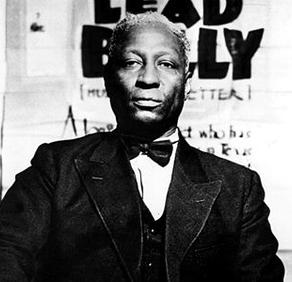
Think about how many times Irene has been wished goodnight in song? I can safely say that it is more than any other typical name. “Goodnight Irene” is one of the most popular American Folk standards. It’s catchy repetition and melody is musically pervasive. Start singing this piece and people will join you. It’s as if it is hardwired in our mental music libraries right with “This Land is Your Land.” We have heard scores of versions of “Goodnight Irene,” but if it weren’t for the man in the picture above and musicologists Alan and John Lomax then we might have never wished Irene goodnight.
Huddie Ledbetter, better known as Lead Belly, may very well be the most influential blues musician of the 20th century. His impact on future generations of musicians was unparalleled. “Goodnight Irene” was, like most traditional blues/folk songs, based on a song that predated it that was lost. Lead Belly, though, rearranged the song and put together his ode to Irene, a love he could not have. While in prison, Lead Belly recorded hours of music for the Lomax’s, and “Goodnight Irene” came out of those recordings. It did not gain popularity in Ledbetter’s lifetime, though, and instead became popular when The Weavers’ recorded it a few years after his death.
The Weavers are perhaps most responsible for the folk boom of the 1950s and 60s that spawned artists like Bob Dylan and popularized music from folk pioneers like Woody Guthrie and Lead Belly.
Clearly, the song has touched competent hands. And, in those hands, it became a staple of their respective performances. The difference between Lead Belly and The Weavers’ versions of “Goodnight Irene” is worth noting. The Weavers initially pick and chose from Lead Belly’s sometimes controversial lyric. For example, the morbidly humorous verse below was not included in the Weavers’ version.
I Love Irene, God knows I do
Love her till the sea runs dry
If Irene turns her back on me
I’m gonna take morphine and die
I can see why the last line of that verse could have sparked some ill-feelings in the time period. They, though, did keep the other suicidal verse (below) so to each his own, right?
Sometimes I live in the country
Sometimes I live in town
Sometimes I take a great notion
To jump into the river and drown
With that all being said, the song is a wonderful classic, and its eccentric lyric and infectious melody stick with us through the generations. Check out one of Lead Belly’s versions and a Weavers’ version of the song.
Willie Ames has toured all 50 United States, distributed 35,000 CDs to the public, and won several solo artist awards including the Solo Artist of the Year in the 20th Annual Los Angeles Music Awards and National Solo Artist of the Year and performer in the Phoenix Music Awards 2011.
So, yeah, more people should know about this folk guitarist/banjoist/singer/songwriter. Ames has been playing guitar since he was five years old, and, at 18 decided to pursue music professionally. He added a banjo to his repertoire at 23.
Ames plays a distinctive style of classic folk music that focuses on heavier percussion, reverberated noise, and a guitar/banjo style that combines the flavor of early Dylan and Dave Van Ronk with heavier folk artists like Amos Lee. Ames then adds a banjo to the mix, and, instead of falling into the bluegrass banjo trap, the music has an edge that sets him apart from other folk musicians. Listening to Ames’ music is fit with unconscious toe-tapping and head-nodding. The beats are almost funky. The sound is multifaceted like a bean dip (light guacamole on top and heavy beans on the bottom). Gosh, I just compared music to a bean dip. If that’s not a sign to introduce a song, I don’t know what is.
“Night Owl,” the title track on the album, perfectly represents what I mentioned above. The beat is authentic. The echoed sounds are reminiscent of a dark night in a deep forest. Ames’ voice reminds me of the Holy Modal Rounders (only slightly), a folk duo from the Lower East Side in the 60s who released an excellent version of “Hesitation Blues.” I hate to be so simplistic, but the song is just cool. I like listening to it.
“Stumbling Home” is certainly lighter. The banjo rhythm is catchy and constant. It’s a great song to listen to if you want to unwind. It relaxed me.
New season. New judges. New top 10. Same show. American Idol is now in its 12th season, and, while it has experienced a drop in ratings, it remains one of the most watched singing competition television shows (a distinguished title, I know). Many have given up on the show claiming it has jumped the shark more times than Fonzi said “Eyy” over the course of “Happy Days,” but I remain a loyal viewer. What can I say; I’m a creature of habit.
If you are a Final 10 viewer (a person who only watches when they are down to the good people), it’s time to turn on the television and tune into the show. You haven’t missed much. Randy Jackson is still on the panel. My father made the perfect analogy when he said that Randy is most similar to a guy who should have left the party several hours ago and now different people have shown up and he is just out-of-place. Mariah Carey represented the big catch this season for show producers. Her voluptuousness has nearly fallen out on several occasions, and her affected speech is vexatious. That being said, she seems to care and she isn’t too bad. Nicki Minaj has surprised me. I thought she would be gimmicky, and, while eccentric, she gives solid criticism (often the most vocal criticism) of the bunch. Keith Urban must think he has hit the jackpot. He genuinely loves the show and the singers on it. Ryan Seacrest is still your indelible emcee, and he is damn good at it.
By now, I have mastered the art of watching the show in 20 minutes. I tape it and fast forward through the nonsense. Some would say that means I must fast forward through the entire show, but, it just means the commercials, monologues, judging, and the awful performers (listen to a few notes and you know if the performance will be good or bad).
PREDICTIONS and REVIEWS:
The Top 10 (In Order from 10th place to 1st place):
10.) Amber Holcomb
Amber was the one throw-away girl choice. There were four girls that deserved a spot. There was one more spot. It went to Amber. She is a cheap Beyonce impersonator with a weak voice and a pretty face. She will be out of the competition faster than you can say her name. She does get to tour with the top 10, though, so, that’s a cool consolation.
9.) Paul Jolley
Similarly, there were four guys who deserved a spot, and Paul Jolley was the “oh well, we need five people in this group.” He does have a nice voice. It’s…nice. He’s obsessed with Carrie Underwood. He won’t make it far.
8.) Lazaro Arbos
Lazaro has a great story. His crippling stuttering does not affect his singing – a smooth balladeer style. The story will only carry him so far, though, and his voice, while good, can certainly become a little boring. I predict a few average performances and an exit in the eight spot.
7.) Devin Velez
Like usual, after the first few out, things get a little muddled up in the middle of the pack. This is tough to predict. Devin has a beautiful voice. He sings in English and Spanish and possesses an intriguing performance quality that can keep him in this show through the long haul. Unfortunately, I see him losing a bit of luster after the first few weeks of top 10 shows and falling into the trap of forgettable. Can he make it further? Of course. He may be a top five candidate. For this incipient prediction, I’m choosing him to leave in the seventh spot.
6.) Angie Miller
A true dark horse. Angie represents the Indie music crowd. She thrives behind the piano and is fit with a powerful voice that can, with the right songs, propel her to a higher final spot. Despite her clear Indie sentiments, Angie may be able to break through into the mainstream. She is pretty. She has a powerful voice. She plays an instrument. These are all good things.
5.) Curtis Finch Jr.
The oldest member in the competition at 24 years old, Curtis may also have the best natural voice. He possesses a rare vocal talent that only few can say they have. His true comfort zone, though, is gospel, and the show has not had a gospel music winner since Season 2. Last season, Josh Ledet, a similar southern Gospel savant, came in third place. This season has three members of the southern soul revival, and I think Curtis comes in third among them. He is the least supportable of the bunch. I know that seems like such an unfounded statement, but the other two gospel-sensitive singers possess an individuality that Curtis doesn’t have. Honestly, though, it’s a toss-up between those three. Can he ultimately make it to the end? Yes. His voice is that powerful. His performance of “I Believe I can Fly” (below) was inspirational. He did some incredible vocal runs. My problem is marketability, and I just don’t see a place for him in today’s musical market. But man can he sing.
4.) Janelle Arthur
Country. Country. Country. Most of the viewers of American Idol love country music. Country wins often. The south wins often. Janelle, a blond-haired, country chick from Tennessee, has the package to win this show. She is pretty. Her voice has a Carrie Underwood twang. She could win. She could also come in fourth and fall short to the other country singer. I see that happening. Why? See below.
3.) Burnell Taylor
Here is the thing about Burnell. He – one of the members of the southern soul revival (the last member is below) – can come in third or eighth. It’s just tough to predict. He is a genuine, Boyz 2 Men type singer. He is humble. His voice is silky smooth (excuse the cliche). He is a true individual, possessing a voice that one of the judges said is distinct and “would know it was Burnell if it came on the radio.” American Idol needs originality, and I think his voice is more diverse than Curtis’s voice. Thus, I choose him finishing at a higher spot. But, like I said, Burnell is a tough man to predict.
2.) Candice Glover
Candice, the last member of the southern soul revival, is a tremendously talented singer with a penchant for vocal strength and bluesy cadence. She reminds me a bit of Jennifer Hudson, and her big voice should help her sail through the competition. While I’m not sure I would label this a “girl’s year,” I do think “American Idol” will have its first female winner since Season 6 and first all-female final since Season 3 when Fantasia won. But, the winner of season 12 will be…
1.) Kree Harrison
Country will win, and its name will be Kree. Countrykree. Kree is not your typical country singer. She adds a southern rock flavor that spices up her performances. She has rangy chops, and her voice just fits today’s country music scene. I can see her laying down tracks that bend country and rock. She can be quite succesful.
Calaca Strides bends genres with a created blend of low-fi, lugubrious melodies joined with bluesy acoustic riffs and upbeat vocals. In some ways, the music may represent a subtle contradiction, but Calaca Strides blends the music together with precision.
Hailing from England, Calaca Strides released Brittle Breezeback in September of 2012, and the four-song EP is impressive in its musical scope. Specifically, the first and last track feature the intriguing musical concoction I mention above.
“Monster,” the concluding track on the EP, begins with a plucked acoustic guitar drenched in strung-out background sound. The song creates an ethereal atmosphere, like an enigmatic sky with clouds vacillating between rain and mist. The consequent euphonious vocals over the rapid playing of acoustic guitar notes creates a medieval aura (much like Amazing Blondel did in the early 70s with “Sinfonia for Guitar and Strings”). The song is an ode to progressive rock and modern folk.
“Row By Row,” is the nearly seven minute opening track on Brittle Breeze. It is an impressive song. I appreciate its multifaceted musicality. The listener is introduced to tremendous melodies that naturally transition into an eccentric mixture of folk/blues (almost like Amos Lee). The sounds introduced throughout the piece are fascinating.
Check out the rest of the album by clicked on it above. Stay up on Calaca Strides on Facebook and Twitter or visit the website.
“Hey Nonny Ding-Dong Alang Alang Alang, Oh, Wo-Wo Bip, a Doh, a Bip, a Bip”
– Genius Gibberish by The Chords
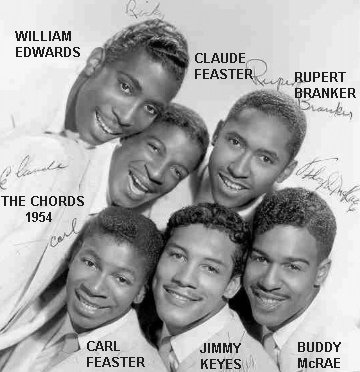
It doesn’t take much to make teenage girls swoon, but “Sh-Boom” (or “Life Could Be a Dream”) by The Chords made everyone swoon when it was released by a sextet of youngsters in 1954. The Chords, though, would only have one hit – “Sh-Boom.” This doo-wop masterpiece represents one of the first one-hit wonders in modern rock n’ roll history, and, despite all of the wonderful one-hit wonders released since it graced the charts, “Sh-Boom” is still one of the best.
The Chords formed in Bronx, NY, and were signed in 1954 after they were heard performing in the Subway. The band brought “Sh-Boom” with them to Atlantic Records’ Cat Records label. Jerry Wexler, who coined the phrase rhythm & blues and would later become a major record producer, was in his second year as a partner with Atlantic Records and proceeded over the recordings. While Wexler initially had the band perform a cover of a Patti Page song, the Chords’ original was too intriguing to pass up (it was put on the B-Side of the incipient record).
Now, if you are thinking that you have never ever heard of this song, just take a listen.
You recognize it now, right? That is how ubiquitous the song is. Even almost 60 years after its release, the song is still noticeable. Why? It is so damn catchy. It is still used in media today. The song’s light-hearted, bubbly harmonies match the jocular lyric. It is warm-hearted song. The gibberish, like I said above, is genius. The song reached #2 on the Billboard R&B charts and #9 on the Pop charts.
“Sh-Boom,” inevitably, was covered for Mercury Records by a doo-wop group named The Crew Cuts who put a more traditional/organized spin on the song. The song reached #1 on the Billboard charts in for nine weeks during August and September 1954.















 The Music Court