Good morning readers. Today, as if anyone really needs a reminder, is Thanksgiving, and I sincerely hope that you all have a comfortable home and family/friends to share the gluttonous holiday with.
Thanksgiving is indeed marked by a voraciousness unlike any other holiday.The food is an obvious component. The plentiful quantity of food and the sleepy combination of tryptophan, stuffing and sweet potato, can make any dieter come out of their shells for one night. Then, after consuming a vast quantity of food, it has now become a quasi-tradition to take advantage of Black Friday deals at major retailers by braving other stuffed souls also looking to get a great deal on a television.
And isn’t it all wonderful. Seriously? I think it is excellent. But while we are celebrating the holiday, please do think of those not in a comfortable situation. Take your spare time to volunteer at a soup kitchen. And, if you simply cannot, donate some money to the cause. Be thankful for your situation, but also cognizant of the needy.
Now it has become a semi-tradition here at the Music Court to profile one particular song every Thanksgiving. The words “song and Thanksgiving” should give the song away. Seriously, this particular song gets its most plays on Thanksgiving, because, well, it was over 40 Thanksgiving’s ago that Arlo Guthrie and his friend went to go visit Alice at the restaurant, not that Alice’s Restaurant is the name of the restaurant, no, it’s just the name of the song!
The perilous tale of Alice’s Restaurant has become as much of a Thanksgiving staple as canned yams. It, keeping with the theme of gluttony, is a whopping 16 minutes long, and, if you have some time to yourself prior to watching the parade in 15 minutes, I suggest you listen to it once through.
Happy Thanksgiving to you and yours! Oh, and make sure to take out your garbage!
I am going briefly atone for all of the times I have disparaged my smart phone (generally for being to slow with internet connection). It permits me to write Music Court posts on the train going to work, and I must thank it for that.
It has been a busy last few days for all Music Court writers. Since Thanksgiving break is right around the corner, this is unsurprising. Trust me. If I could, I would write more and more. Luckily, Peepirate and Okocim have been able to provide cogent posts on a consistent basis. I am thankful for that.
They say a picture is worth a thousand words. Well, this photo perfectly portrays my usual Fall Sunday.
Accurate Portrayal
And, yes, while I do enjoy watching my fair share of football (fantasy football implications), because of the mediocre play of the NY Jets (and the fact that they rarely play on Sunday afternoons it seems), the entire act has become slightly trite. That’s why it was enjoyable to change it up this past Sunday.
Rebecca (my girlfriend) and I visited my stressed first year medschool buddy Josh and his girlfriend Amanda (both of Music Court fame) in Greenwich village. It was a rare opportunity to see the duo, what with Amanda still in her senior year at Binghamton and Josh buried up to his neck in medical terms and practices. Our city pursuit? The Ron Pope concert at Dominion on Lafeyette.
I love small bar/venues. There is a cozy intimacy that spawns from the dim-lit bar, low cushioned seats, and open concert floor. It is particularly exquisite when the space is not cramped. Luckily, the venue took on this well balanced flavor on Sunday night, and, because of space, the sound remained vibrant and decently mixed through the night. If it wasn’t for some dude consistently ripping violent, odorous, mexican-food farts throughout our stay, the venue would have only taken on the aroma of yeast, hops, and cologne, like that of an uppity bar, and that would have been just fine.
Ron Pope came on after two singer/songwriter opening acts. But while these acts filled the same broad genre, it is important to cite their differences. Let me premise this opening act review by assuring you that they are both worth a listen.
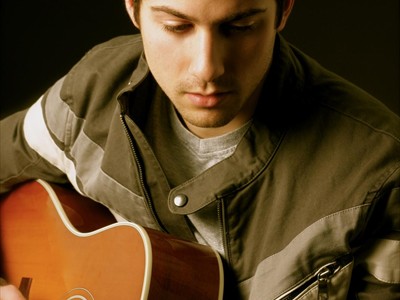
Alexis Babini
Alexis Babini does not like being compared with John Mayer. At least that’s what he told the Dominion crowd in the middle of his setlist. An iTunes review labeled him as a Mayer-like artist. Don’t worry, Mr. Babini. I have no intention of comparing you to John Mayer. I actually think that label is wrong. Babini, a 24-year-old musician from New York, fits comfortably into the singer-songwriter genre, yes, and while that can make him like Mayer, his distinct pleasant vocal and acoustic flavoring, makes him different.
Babini, proficient in guitar and piano, fits the mold of a Joshua Radin/Joshua James folk musician, with catchy, head-bopping, creative rhythms. His music is accessible and it evoked smiles from the crowd. I think that was the most important aspect of his performance. I must admit that after he tackled his first few songs, Amanda turned to our group and exclaimed, “He sounds like Paul Simon,” and pretty much right after that Babini sampled “Cecilia.” We exchanged glances and started to hysterically laugh. Credit to Amanda. He elicited smiles from the crowd and even engendered a call-and-response sing-along in his song “Smoke.”
This song implanted itself in my mind for later usage. Before I began writing this post, I found myself humming the chorus. That’s an excellent thing that Babini has going for him. His music is infectious. This is similar to his co-opening act who I will look at…now!
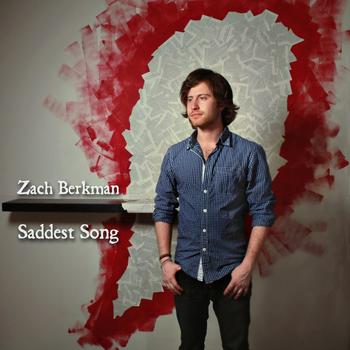
Zach Berkman fits a different singer-songwriter profile than Babini. His voice is different and his rhythms more staccato. He too plays melodious, radio-ready pieces, and he is also guitar/piano proficient. Berkman’s creativity oozed through his set-list. His riffs were original and neat and his acoustic sound resonated.
Like Babini, Berkman, originally of Illinois, has had his songs used by TV shows (no surprise for both as they play excellent teenager-friendly, drama, television music). His strength, as displayed in the song above, is his powerful voice, high, but also expressing a full range.
While I had little difficulty placing Babini’s sultry voice, I had to search through my brain to think of a comparison for Berkman. I thought of two, one during, and one after the show. Berkman has a twang to his voice like Brett Dennen, but a true similarity, especially with the above song, to Eric Hutchinson (listen to “Okay, It’s Alright With Me”). While Hutchinson has more of Michael Buble’s rat-pack croon, I feel that Berkman can fit into this category. And, I believe he is most effective there. “Hero” is an excellent song.
Ron Pope
We move on to the headliner, Ron Pope. Pope, originally of the Greenwich village scene, is a consummate musician, one who maintains the rare ability to musically multitask. Pope can sing a delicate, heartfelt ballad, and then rip out a guitar solo (like he did with a mid-show “Little Wing” tribute – see below) just to keep you honest. I both enjoy and respect musicians who have this ability. Pope, who hid his face behind what looked like a no-shave-for-November bushy beard, played an excellent show that displayed these varieties of style. His pop/blues superiority was respected by a crowd of around 50-100 that sang along with his lyric and gyrated with his guitar.
I went into this show not knowing much about Pope. Amanda and Josh both enoy his music and I first heard of him when Josh played me a song or two several months ago. I enjoy going into concerts with no expectations. If I do not know what a person sounds like, I can make an unbiased judgment on their music. I must say I was quite impressed by the five-piece band. They balanced the variety quite well.
“A Drop in the Ocean,” which was co-written by Zach Berkman, was one of the most popular songs of the night, and it demonstrates Pope’s intimate side. The song is a slow, powerful ballad, that is carried by his voice. Without Pope’s croon, the song could easily fall into the hackneyed category. But it rides the line well and remains an enjoyable and authentic piece.
Yeah, he can also rock the hell out. If I take away anything from his performance it will be an envy of his rock diversity. It is impressive and wonderfully executed.
Pope had Berkman and Babini join him on stage (as well as some other friends) for a joint performance of Neil Young’s “Hopeless” to conclude the show. The resulting sing along was tasteful and wonderfully loud. There was a smile on the faces of everyone on stage, especially a grinning Pope, who soared high above everyone standing on a piano stool, screaming “Helpless” at the top of his lungs with the appreciative crowd.
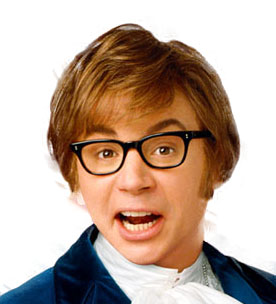
How weird is it that the last Austin Powers movie was released almost a decade ago? My mojo reference is dated. No, Austin Powers is still a fresh memory. Plus, he is perfect for this post.
“Got My Mojo Working” is a fast-paced, haromica-driven blues song popularized by the great Muddy Waters. His 1957 version of the song became the one that most people cite when they think of this prime example of fast blues. There is no denying it. Muddy’s smooth croon and hedge-like slick black hair make the song slippery and a little dirty. What made Waters’ version so popular was its skilled use of call-and-response and James Cotton’s “I’m better than everyone here” harmonica. It is so proficient it’s scary. But when people say that Muddy Waters created this song, they are mistaken. While he did manipulate elements of this famous blues hit to fit his mold (and this definitely contributed to its popularity), the song was written by Preston Foster and first recorded by Ann Cole in 1956.
Cole’s version is more jump blues than traditional blues. The doo-wop background singers, backing high-pitched guitar, horns, and Cole’s poppy voice contribute to this conclusion. That is not to say that this original version is not good. No, it is great. There were lawsuits (of course) between record companies – claiming that Muddy stole the song after hearing Cole perform it. Whatever, that stuff was settled and it is unimportant. There was, however, a humorous ruling by the court when another performer claimed that songwriter Preston Foster stole the concept of “mojo” from her. This was the ruling:
“MOJO is a commonplace part of the rhetoric of the culture of a substantial portion of the American people. As a figure of speech, the concept of having, or not having, one’s MOJO working is not something in which any one person could assert originality, or establish a proprietary right.“
Mojo should be shared by all. Now, here is to hoping that the Jets have their mojo working for their Thursday Night Matchup against the Broncos tonight! To sponsor this sentiment here are some more performers showing their mojo off.
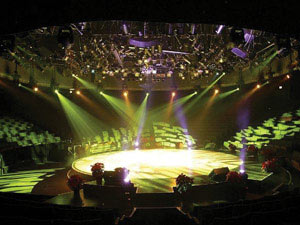
During the brief car ride from my house to Westbury Music Theater (NYCB Theater at Westbury — whatever they are calling the once Westbury Music Fair these days), my father and I laughed about a surprising tidbit about the Doors that we learned from my brother. In April of 1968, the LA-based rock band – one of the most celebrated bands to come out of the era of peace and love – played the Westbury Music Fair. The Doors, at full-strength, played a small venue a short drive from my house (a brisk 10 minute walk from my gym). We laughed because of how odd such a story seemed. The Doors playing Westbury Music Fair at the height of their success?
The Doors did in fact grace the tent-like circular stage of the Westbury Music Fair on Friday, April 19, 1968. 3,000 upholstered seats of the brand new theater (which was an actual tent until 1966). And, for reasons unbeknown to anyone but the men themselves, they played two shows. One, a poorly attended early bill…on Friday afternoon. The second show was at night and Jim Morrison wasn’t having any of it.
For an account of the concert I want to turn to a piece I read online which I think perfectly describes the mercurial Morrison and the contradictory apoplectic and apathetic show that he put on for the New York crowd.
“Morrison wasn’t on stage when the music began. Suddenly there was a confrontation on one of the downhill aisles leading to the stage. He stumbled down the steps, entangling his black leather and a mass of tangled hair with the offstage darkness. He stopped to pose, and a flash of light caught him trying to regain his balance. The taunts began immediately. He responded with force indifference or a threat of random violence. The other Doors were in other rooms. They played on, almost oblivious to his ranting and raving. A familiar riff would begin, the audience would briefly come to attention, and he would leave the spotlight to inflict his boredom on them. He would fall into shadows searching for worthy opponents. There were glimpses of physical confrontations: crewcutted jocks protecting their interested girlfriends from his suggestions. Morrison’s fist shooting blindly in the direction of obscene threats as a fat security guard grabs at him with a pathetic attempt to control the situation. Morrison embraces the guard and tries to pull him towards the stage while delivering a passionate plea for weight loss. The guard frees himself, runs up the aisle to derisive laughter, dropping his hat. Morrison tries to wear the hat but it is too small and suddenly he is disgusted with the whole scene and lets out a frenzied scream. Silence in the theater for the moment. The audience stared as though it was a horrible car crash where the spirit was maimed and the blood ran into the gutter of the soul. Morrison twitched in some kind of death throes. The concert ended abruptly. Morrison howled but it was not with ecstasy. It was more Ginsberg than Blake. The lights came up before the band could walk back up the aisles and the audience booed. Morrison stood still listening. I stared so that my eyes would forever cover him. Some people were leaving, others still booing, a few watched him as intensely as I did. Then in this haphazard atmosphere he threw back his head and began to chant and dance in place like some possessed American Indian brave consecrating a sacred land, cleaning the abuse and disdain with singular belief so powerful that shivers ran through me. And my heart froze with undeniable blessing. A girl ran at him with scissors flashing to cut his hair and he disappeared into a circle of anonymous flesh carried him away.” (David Dalton. Mr. Mojo Risin’. New York: St. Martins Press, 1991)
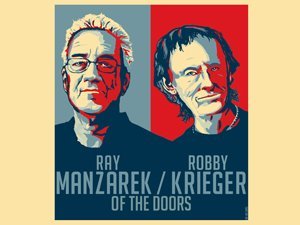
It sounds more like an orgy than a rock concert. If you need any evidence of Morrison’s, for lack of a better word, showmanship this is your proof. Screaming vocals, blind punches, random hugs, sarcastic remarks, demonic dancing. The works. Don’t you love it? A little more than three years later Morrison died of a drug overdose. But he certainly left his mark on the Westbury Music Fair. And, on Friday, Nov. 4, Doors’ keyboardist Ray Manzarek and guitarist Robby Krieger came back to the Westbury Music Theater.
Westbury Music Theater
It is important to get one important point out of the way prior to my review of the concert. Ray Manzarek and Robby Krieger are perpetually underrated at their respective instruments. The Doors would have not been the Doors if they did not have these musicians (and drummer John Densmore – who also was an essential part of the band’s success). While Morrison was the glue that made everything stick together, there would have been no Doors without the skill and inspiration of his band-mates. He would have been the first to tell you that.
The concert began 30 minutes late (a staple of Westbury Music Theater concerts – always waiting for the last person to get a drink and settle in). The lights dimmed and Manzarek and Krieger came on stage with their band, and a faux-Jim Morrison named Dave Brock (the leadman of The Doors cover band Wild Child – and a decent Morrison look-alike). Manzarek spoke first.
“We played here before. 43 years ago!”
The crowd erupted. I looked at my dad and we both gave each other the same wide-eyed look. We were wondering if they would mention their past performance.
“And, we are going to play the same set list we played last time we were here!”
Manzarek spoke with vigor, his voice loud enough that the microphone wasn’t even necessary. Krieger and him laughed. The crowd was flabbergasted. How cool! The same set list? What an exciting opportunity to re-live that date in time. Brock stood up to the microphone and Krieger struck his guitar.
“There’s blood in the streets it’s up to my ankles,” the crowd yelled, making Brock’s microphone-aided croon inaudible with their own rendition of one of the most famous opening lines in Doors’ history. On the following line Brock’s vocal found its way over the electric crowd’s communal voice and, wow. I closed my eyes and imagined 1968 (well a more sober performance). Impressively, Brock’s performance echoed Morrison’s vocal mannerisms. A truly accurate copy. He stepped back from the microphone and (in a move that he would do several times during the night) allowed a youthful Manzarek (72 years old) and Krieger (65 years old) to occupy the spotlight. It was their show. That was tasteful. When I opened my eyes (and was transported back to 2011) I realized that despite the fact that it was 2011 and Jim Morrison was dead and John Densmore was not performing with the band any longer, this incarnation of the Doors was perfectly suitable. The performances oozed with power and talent, a beautiful mixture of crowd excitement and band appreciation. Everyone was having a good time (especially the men themselves).
The band trucked through hit after hit – “Roadhouse Blues,” “When the Music’s Over,” “Alabama Song” – all excellent performances that the crowd sapped up with comfort.
Before I talk about the performance of the night (and one of the better performances I have ever seen at a concert) I’d like to briefly discuss “Soul Kitchen” a lesser-known Doors song that, before played, Krieger remarked he didn’t think they had played as a band in…43 years.
This is an excellent, underrated Doors song that was a pleasure to hear. The repetitive bass-line was carried well by Phil Chen and drums by Ty Dennis. The rendition of “Soul Kitchen” was memorable because of the flavor that the band put into the song. This made the rarer Doors’ song accessible to some of the crowd that may have been unfamiliar with the song (even though it did seem like the crowd knew every lyric of every song). This, obviously, was no issue with “Light My Fire.”
Think of everything you love about The Doors – the energy, sexiness, ruthlessness, originality, togetherness – and throw it into a pot of boiling liveliness and love. Let that boil for around a 20-minute epic performance of “Light My Fire” that neared mystical levels and you have a great performance. Brock’s voice was spot-on, his Morrison-like yell satisfactory. Chen and Dennis both sustained some small solos. Hell, even Ray Manzarek’s brother Rick was on stage adding to the percussion. Manzarek’s keyboard was perfect. No other word. Midway through the performance, Manzarek stood up from his stool, kicked it over, and swiftly put his right foot on the keyboard! 72 years old, my ass. Krieger responded with shredding guitar solos (several of them). Near the end of the song the entire band got together on the stage and, in a Rockette’s line, moved back and forth like family. And, for Manzarek and Krieger this is what performing is to them now in 2011. It’s family. To quote radio-legend Cousin Brucie, the fans are cousins.1968 or 2011 – Manzarek and Krieger are still rocking – both vivacious as ever showing no signs of slowing down.
P.S
On the subject of the Doors, did you see Jimmy Fallon’s Jim Morrison impression his late-night show the other day. Many don’t realize that Fallon is true comedian with an aptness for impressions. His accuracy is scary.
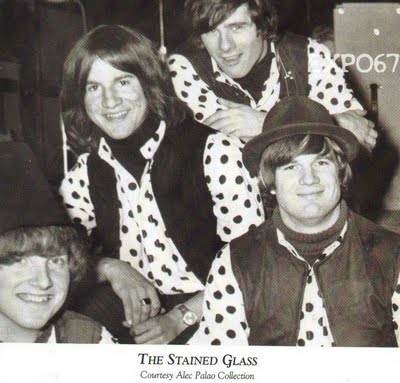
Another Obscure Classic Rock post and another underappreciated band. Stained Glass was a pop band from San Jose, California, that was formed in 1964 by Jim McPherson, bass, Roger Hedge, guitar, Bob Rominger, guitar, and Dennis Carrasco, drums. They all provided vocals.
After being signed by RCA at the end of 1966, Stained Glass was instructed to record a version of the Beatles’ “If I Needed Someone.” RCA estimated that the Beatles were not going release the single in the US for a bit of time, and their slight miscalculation probably impacted the limited success of Stained Glass’s version, but, the song garnered enough airplay to spark a brief East Coast tour for the California band. The immediate follow up to the band’s first single was “My Buddy Sin”/ “Vanity Fair” which was released in the same year. We are going to take a listen to “My Buddy Sin.”
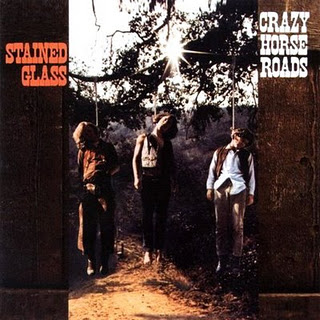
“My Buddy Sin” moves like a merseybeat tune (and this is understandable because their last recording was just that, a Beatles’ merseybeat song), but the band adds in some other elements that makes this song stand out. First off, the vocal harmony is unorthodox. It is not your typical light-hearted, fast-paced, early Beau Brummels’ like American merseybeat harmony. No, instead, it almost takes a page out of the Association’s handbook. The harmony is rich and delicate. It is fresh and entrapping, more like a choir than a pop group. The song also features a bluesy harmonica and a fast-paced blues guitar solo over an angelic vocal background. It is an odd mixture of genres, some popular at the time, and some prescient (British folk, for example). It, to me at least, seems like a strong second release. A great song. It is overlooked though, in favor of the band’s 1967 version (and following single) of “We Got a Long Way To Go,” which is, despite its popularity, a little trite and uninspiring. After another follow-up single and the departure of Hedge, Stained Glass released their first album Crazy Horse Roads, which is perhaps best known for its controversial cover (see picture below), but should actually be known as a strong release from a budding psychedelic band that sampled strong vocal harmony and garge rock flavor.
Sort of - Kind of - Definitely distrubing
The needle touches down on typical fuzzy garage-rock guitar, Stained Glass harmony, psychedelic sampling, and hints of folk. It is wholly diverse and filling. Yet it did not, and still has not, gained the recognition it deserves. This case kind of surprises me. Stained Glass was too good of a band to just fall into obscurity. They were able to fuse genres and that generally leads to success. Perhaps it also sometimes distracts listeners. I am including the most accessible song from the album and one of my favorites.
Listen to McPherson’s driving, funky bass and Rominger’s loud hollow-bodied electric with fuzz. Catch the vibes. The psychedelic flavoring can be heard in the riff and solo, as well as the echoed choral endings. I hear Blues Magoos and a little Count Five. Pretty much, Stained Glass should have gained more success than they did and that is unfortunate.
In 1969 Rominger was replaced by Tom Bryant and a second album, “Aurora” was released which didn’t sell well either. The group disbanded in 1970. According to the wikipedia page for the band, the very talented Jim McPherson died in 1985. Dennis Carrasco lives in the San Jose area. Tom Bryant lives on the east coast. Bob Rominger lives in Newnan, Georgia.
 Good morning readers. Today, as if anyone really needs a reminder, is Thanksgiving, and I sincerely hope that you all have a comfortable home and family/friends to share the gluttonous holiday with.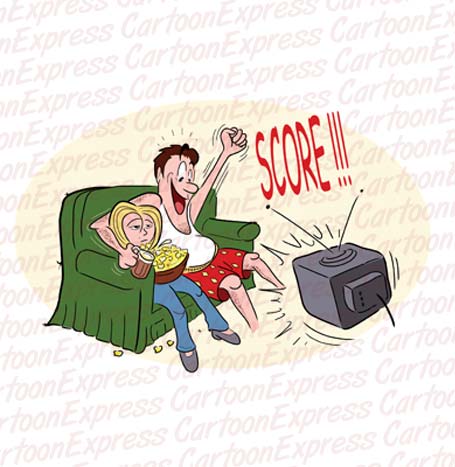

 The Music Court