Song of the Day #51: “In the Year 2525,” by Zager and Evans

18 Aug

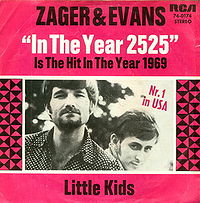
In 1969, while the Woodstock festival literally took over the entire music world for a few rainy days in August, a song was finishing its six week reign as the top song on the billboard hot 100 charts. It is a great trivia question. What was the #1 song on the charts during Woodstock? I was asked this, and stumped, by my girlfriend’s father’s friend. When he told me I did not have an “ohhh! of course” moment. I was a bit surprised. In what I believe is the first, and probably only, prophetic science fiction song ever to chart as a complete one hit wonder (well that is quite specific) Zager and Evans hit big in their musical warning “In the Year 2525.”

In the Year 2525

Did you know that the b-side of the “In the Year 2525” single is a touching tale of young love entitled “Little Kids.” Yeah, I did not know either. This is the definition of a one hit wonder. Plus, I believe that it is kind of hard to repeat after writing a song about human’s being overtaken by technology. In a year where the space program reached the height of their productivity by landing on the moon (coincidentally the song about how human’s are incredibly dependant on technology and this will lead to their downfall was #1 on the charts when human’s first landed on our moon. Awkward! You can’t make this stuff up) Zager and EvansZager and Evans were putting technology down.

Since this is not a lyric of the day I will not bore you with their lyrics which progress through each thousand ten year intervals until 6565 and then continues with some more years up to 9595. The song’s main message is that technology will slowly dehumanize humans (The Police would obviously be a fan of this prospect). This sort of sounds like the book 2001: A Space Odyssey by Arthur C. Clarke and the corresponding movie in 1968 by Stanley Kubrick about a space ship’s computer system rebelling against the humans on the ship. The song was written by Rick Evans in 1964 and made public a lot of science fiction fears that had been outlined in numerous books written before the song.

In the year 9595 man has taken all the Earth has given him and has not put something back. Sound familiar? The verse continues mentioning that man’s reign is through. But through eternal night, The twinkling of starlight. So very far away, Maybe it’s only yesterday.

This, of course, leaves open the possibility that this may have happened on a far away planet and now it is happening again, here, on Earth. OH NO. Watch out for your toaster. It is coming to get you.

Lyric of the Day #51: Top 100 Lyricists #96

17 Aug


     On August 17th  1969, threatening Sunday afternoon skies welcomed Joe Cocker’s incredibly spastic, but amazing, soul-searching set at the site of the Aquarian exposition in White Lake, NY at around 2:00 p.m. (Oh no! Another Woodstock post. Man, this kid is obsessed with something that he learned through documentaries and his parents. Stay with me guys you will see how it all makes sense. Well, there I go talking to myself again.) At the time I am writing this post he was most likely belting “Do I Still Figure into Your Life” or “Feelin Alright,” but I am not entirely sure, I am just going by the set-list. After Cocker’s set a torrential downpour shut down the event for around four hours. Who knows? Maybe, Cocker’s strained voice sent the clouds in frenzy and the rain a’pourin. Or, maybe it was just a normal August thunderstorm. After the rain delay a band whose name mixed both Joseph Stalin’s nickname (Country Joe) and Mao Tse-Tung’s statement about how the true revolutionary swims through the peasantry (The Fish) into a combination of protest songs and witty chants, opened the concert again. Their lead singer-songwriter, performing for the third time at the festival in three days. A record for sure for a man who stayed firm in his belief for peace and love and still does to this very day. The number 96th greatest lyricist of all time, Country Joe McDonald.


            Four days ago I went to see a quasi-Woodstock reunion with a few original members of some of the better bands that performed at the Woodstock music festival. There was Big Brother and the Holding Company, lacking the pretty key Janis Joplin component, Canned Heat, lacking lead men Bob Hite and Alan Wilson, and even a twisted and odd version of Jefferson Starship (the band that was formed out of the original band from Woodstock, Jefferson Airplane. The music was fresh oldies though and the crowd was excited to see the originals pound away at their new drum sets and guitars (most likely purchased after the Woodstock festival), but nostalgia could only carry the sets so far. But, out on the stage after every act in a tie-die t-shirt was an older man with glasses, shaggy grey hair, and an acoustic guitar strapped to his neck like a weapon of peace. Yes, under all of the wrinkles and grey hair was the same young man that seemingly was out and about each day of Woodstock, on stage in front of hundreds of thousands. Performing in front of a crowd of One thousand and five hundred at best was Country Joe McDonald, still plucking that acoustic guitar and singing for peace after all of these years.


            After Woodstock ended forty years ago tomorrow, the spontaneous gathering of peace and love was gone. The endless line of muddy faces and bodies were cleaned, the butt-naked men and women were clothed, and the thousands who once roamed the field of Max Yasgur’s farm looking for some acid or pot or water or food (the basic necessities of late 60’s existance) were gone, only their mess left to clean up. As curly-haired concert promoter Michael Lang left the site by helicopter to visit bankers waiting to scorn him for losing so much money at the event he spotted out of the helicopter’s window a large crop-circle like peace sign made out of garbage. A beautiful site constructed out of dirty papers, bottles, and simple waste. The garbage peace sign could really be considered eerie and prophetic. It only took a few months later (December, 6th) for peace and love to turn into pure hatred and fighting at The Altamont Speedway Free Festival, the Rolling Stones attempt at Woodstock. For some reason The Hell’s Angels, the rowdy motorcycle gang, were asked to provide security because the stage was only four feet high. Look, if members of The Hell’s Angels wanted to come to enjoy the show, sure, the more the merrier. But, hiring a motorcycle gang to provide any type of security is just asking for trouble and trouble they definitely received. The Vietnam war was still raging, the Kent State massacre came in May of 1970, less then a year after Woodstock, and the garbage peace sign, the odd symbol of both beauty and, well, trash, had been cleared away and the farm in upstate New York turned back into a farm. But, the one man that continues to keep trying for peace is Country Joe and his protest music is the reason why he is #96 on the list.

            People may inquire how a guy who profited on a comedic protest song could beat one Don McLean or Ray LaMontagne. A fantastic argument can be made against my case and I welcome the feedback (seriouly somebody talk to me, I am lonely in the blogosphere.) But, in my warped opinion, I feel as if Country Joe’s body of work is more significant then these other fantastic lyricists. His anti-war lyrics or not only comedic, some are rather serious, and his tireless efforts for peace are just incredibly honorable. He does not have to be Bono or Bob Geldof, who, while being noble in their goals, also have an ulterior motive in cash cow schemes to make exorbitant amounts of money through benefit concerts. He just can easily list off members of Sullivan County, the town that encompasses Bethel, NY (where Woodstock took place), who were killed in both the Vietnam War and Iraqi/Afghanistan war before and after his black comedy anti-war hit, “The Fish Cheer & I-Feel-Like-I’m-Fixin’-To-Die Rag.” Subtle mentioning of the horrors of war. His staggering lines in his anti-war songs also are delicately placed in the music for effect. Check out these lyrics from “I-Feel-Like-I’m-Fixin-To-Die,” off of the self-titled 1967 album by him and his Fish.

 “Well, come on mothers throughout the land,
Pack your boys off to Vietnam.
Come on fathers, don’t hesitate,
Send ’em off before it’s too late.
Be the first one on your block
To have your boy come home in a box.”

 Be the first one on the block to have your boy come home in a box. It is just like, Woah. Did he really just say that? It is such a witty line and it is set to the backdrop of an old-time late 20’s rag song. But, it is and still is true. Now let us look at the lesser known, “Here I go Again,” off of the 1969 album “Here We Are Again.”

 “Father’s gone to fight the war,
He left us here alone.
I shiver in the lonesome night
Beside the telephone
But time brings no word,
I guess he’s not coming home,
It feels like the end,
It feels like the end, my friend.”

            This lacks any humor because there is no humor in war. Protest songs can be catchy and, in a sense, somewhat comical because war is obviously an incredibly dumb part of human existence, but when a father leaves for war and a child is left alone pondering whether he will ever see his father again the situation is certainly not comical. War is terror and peace may never possibly be able to exist in a world with so much violence, but Country Joe McDonald will for the rest of his peaceful life through attempt to bring a little peace with his lyric wherever he travels. This, in my opinion, is good enough for now.


 peace-sign.jpg peace sign image by dizzidee_2007

Song of the Day #50: “Freedom,” by Richie Havens/ Celebrating Woodstock

15 Aug

         On August 15th, 1969, a concert billed as an Aquarian Exposition began on Max Yasgur’s 600 acre dairy farm in Bethel, NY. Who knew that the concert, known to practically all as Woodstock, would draw over 500,000 people over a rainy weekend of thirty-two musical acts? Who knew that forty years later the concert would still be fresh in the minds of all who lived through the event and would be known as possibly the greatest event in Rock history? If you asked people then, except the confident group of promoters, an answer of “you gotta be kiddin’ me” or a long drawn out “no wayyyy mannn, you want a hit” would most likely be the common answer.           

        Yes, the year of 1969 was both a year of great success (the moon landing) and great unrest (The Vietnam Conflict) and music was accordingly at a turning point. Rock was becoming more experimental, or psychedelic as some would come to call it. The good old days of “I Want to Hold Your Hand,” and “I Want to Grow Up to Be a Politician” had turned into The Beatles singing that Happiness is a warm gun and Roger McGuinn singing about how he wished he could be an easy rider and let the sea carry him out of war and conflict. The times were certainly changing again and young teens were becoming angrier that their country continued to send men of their age to die in a hopeless war. In hindsight, I guess the turn out (or turn on) at Woodstock was not surprising. Teens hear about a concert that is going to promote a weekend of peace and love in hopeful support of a movement against the war. At the time would you say no? Whatever it may be, the Woodstock Music Festival was born and hundreds of thousands of people came to turn on, tune in, and drop out.

            So, in celebration of the 40th of anniversary of Woodstock let us look at the only musical performer in history who ended up being plagued for his punctuality, Richie Havens. Well, it wasn’t really any other performer’s fault, except maybe Tim Hardin (who came by helicopter and would have opened the concert if not for being too stoned to get on stage. Technically, Sweetwater was supposed to open the show but they were experiencing band problems). You see traffic was so bad on 17B the highway that was used to get to White Lake, NY (and the same one that can be used to get to Binghamton University, my place of learning), that concertgoers decided eventually to abandon their cars on the highway and walk the rest of the way. Can you imagine those few cars on 17 going to visit their cousins in Vestal, NY. “Morris, we’re already late and they said that they are serving dinner at 6:00,” says agitated wife with a voice like Fran Drescher. Okay, I am digressing stupidly.

     The point is that at 5:07 pm Eastern Daylight Time, Richie Havens walked on stage and performed “High Flyin’ Bird,” officially opening the festival. Three hours later, Richie Havens’ fingers were falling off and his oversized thumb was most likely bruised and dirtied by acoustic guitar strings. He was still on, asked to continue his set until he ran out of songs in his repertoire. All joking aside, he did not know any more songs to play. After doing “Handsome Johnny,” a scared look must have been in his eyes. So, do to his quick thinking and large thumb, “Freedom,” the unofficial anthem of Woodstock, was composed for the first time right on stage. Richie Havens improvised possibly the most important song in the entire show.  

            Strumming wildly and convulsing to the beat he merged a new composition, “Freedom,” with the tradition “Sometimes I Feel like a Motherless Child,” which dates back to the days of slavery when black children were commonly sold and ripped away from their mothers. The song lifted the growing crowd off their feet and was over five minutes of pure emotion and, in a sense, possible exasperation. Just kidding! Richie Havens is a true performer and a real amazing mind. The end of the song which sees Richie Havens get up from his seat while the song crescendos reveals a glob of sweat on the back of his brown dress-like shirt. That, my friends, is hard work. Woodstock would have not been the same without the opening act of Richie Havens. One must give credit where credit is due and he certainly deserves the credit. Happy 40th to Woodstock and enjoy the anniversary with some Richie Havens links I am posting below.


Check it Out:

“I Can’t Make it Anymore,” Woodstock: http://www.uulyrics.com/music/richie-havens/song-cant-make-it-anymore/

“Strawberry Fields Forever,” Woodstock: http://www.youtube.com/watch?v=IQG-xM62tQg&feature=fvw

Woodstock- “Freedom”: http://www.youtube.com/watch?v=o-d5x-CiTUs&feature=related

Lyric of the Day #50: Top 100 Lyricists #92

14 Aug
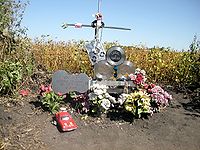
The Crash Sight

The Crash Sight

A large post for #50. Enjoy!

Just after 1:00 a.m on February 3rd, 1959, a beechcraft bonanza B35 holding enough talent to fill up numerous stadiums, crashed due to pilot error and poor weather conditions near Clear Lake (miserable irony), Iowa, killing all four flyers, including the pilot.  The three musicians who were killed, none older than 30, were Buddy Holly, Ritchie Valens (he was 18), and J.P. “The Big Bopper” Richardson. The story before the crash is riddled with upsetting coincidences and haunting decisions. After a show at the Surf Ballroom in Clear Lake, Iowa (which was not an intended spot on the tour), Buddy Holly became frustrated with the tour bus (which had already given drummer Carl Bunch frostbitten feat because the heating system on the bus had broken down) and told his bandmates his plan to hire a small plane to take them to the next stop. The plane could hold three flyers for 36 bucks a pop. The Big Bopper had developed a case of the flu (possibly because of the cold bus) and asked Buddy Holly’s band member Waylon Jennings for his seat. Jennings gave it to The Bopper and after Holly heard about the trade he proclaimed jokingly to Jennings, “I hope your ol’ bus freezes up. Jennings responded, “Well, I hope your ol’ plane crashes.” He has never been able to live down those words. Ritchie Valens won his first trip on an a small aircraft by route of a coin flip. Kind of reminds you of when Jack wins his ill-fated trip on the Titanic by winning a card game. Okay, probably should have kept that analogy to myself.

It is funny how people can look at events that happened prior to a miserable accident and blame themselves for the otherwise regular day-to-day things that had occured. If the plane did not go down maybe rockabilly music would have lived on into the 60’s competing with the British Invasion of Rock and Roll. But, who knows. Music did live on and the 60’s brought possibly the most impressive cultural explosion of Rock music, but, on February 3rd, 1959, momentarily on that cold night rock’s future looked noticeably bleak and 12 years later a man decided that he still could not get over the events of that dark morning. So, in October of 1971, the first track of Don McLean’s second album wrote of an abstract story about the day the music died in 1959. The album and the song were both titled, “American Pie.”

Similar to Ben Gibbard of Death Cab for Cutie (#98 on the lyricists list) many can make the claim that the only reason why Don McLean is considered one of the top lyricists is because “American Pie” was such an influential song. Hey, when someone can describe an entire music generation in a seven minute epic I do understand the reasoning. It sure is his hit and I will portray to you faithful readers what specific lyrics in the song I find to be fantastic. But, what many people seem to forget is that besides all of the understandable hooplah that surrounds “American Pie,” McLean recorded other tracks and one in particular that maintains comparable lyrics to “American Pie.”

Yes, for all of you who are going hey is that not Vincent Van Gogh’s “Starry Night” painting that is not music, it is indeed the Van Gogh masterpiece and it also ties in perfectly with Don McLean’s admiration and tribute to Van Gogh. “Vincent,” is a masterpiece itself, playing with lyrics that paint a picture of a Van Gogh landscape with words. McLean describes through luscious metaphors and pastoral imagery how many did not understand Van Gogh, but now, finally they all possibly can. Take a look at some lyrics

Starry, starry night
Paint your palette blue and gray
Look out on a summer’s day
With eyes that know the darkness in my soul
Shadows on the hills
Sketch the trees and the daffodils
Catch the breeze and the winter chills
In colors on the snowy linen land

Now I understand
What you tried to say to me
How you suffered for your sanity
How you tried to set them free
They would not listen they did not know how
Perhaps they’ll listen now”

The first verse of the song that is written above is a wonderful explanation by McLean of an artists work. Their, sometimes hair-pulling attempt to portray that beautiful summer day on the “snowy linen land” that is the emptiness of a blank canvas on a painter’s easel. Most similar to a blank page’s glare on a lyricist. The chorus of the song holds so much beauty because McLean encaptures the struggle that Van Gogh had to go through. How he “suffered for your sanity.” How people during the time did not listen, did not understand, until he was dead. McLean ends his chorus proclaiming, “Perhaps they’ll listen now,” which is as touching as his lyric at the end of his masterpiece, “American Pie”.

The lyrics that I like the most.

“And the three men I admire most
The Father, Son, and Holy Ghost
They caught the last train for the coast
The day the music died”

Well doesn’t that describe it all. The song culminates into this ending statement. The only statement that makes any mention to the three men who died in the crash. The three men whose unfortunate demise was possibly the most shocking musical event in the 20th century. They did symbolically catch the last train for the coast on Februry 3rd, 1959. On the day that the music died.

Check out both songs:

“Vincent”- http://www.youtube.com/watch?v=dipFMJckZOM

“American Pie”- http://www.youtube.com/watch?v=S6uEjifqTaI&feature=related

Les Paul 1915-2009

13 Aug

           What many do not realize is that without Les Paul there is no rock and roll. No Beatles, No Stones, No Jonas Brothers (ew! Maybe he should have put a limit on who can use the guitar). Les Paul, besides being an incredible guitarist, was a rock pioneer and his invention of the solid bodied electric guitar kind of started a pretty big movement in music. I mean can you imagine an unplugged performance of “Enter Sandman” in Madison Square Garden. Yeah, probably wouldn’t sound so metal. Les Paul, rock god, unfortunately passed away today at the age of 94 and instead of focusing on lyricist #97 I thought that it would be only right to pay my respects to the man who shaped 20th century rock and roll by focusing on his incredible life in this post.

Les Paul

  Les Paul was a tinkerer. A life long experimenter. Give him a musical object and he would search his brain for ways to make it work and sound better. He also was like any performer who is young at heart. He became easily bored. That is one of the reasons he created the solid bodied electric guitar in the first place. The acoustic guitar simply wasn’t making the cut anymore and Paul wanted some more sound. So, at the same time that Leo Fender also was experiencing a similar dilemna, Paul went on a mission to create a guitar with an electric sound. The project resulted in his famous “Log” (the guitar prototype), a 4 x 4 aptly titled piece of lumber which came with the full works (guitar neck, fret board, and, of course, a pickup). He then slapped on the body of an Epiphone hollow-bodied for the appearance. The result. Well, this:

 Look familiar. Yeah, those rock artists today you see performing with a Les Paul in concert are using variations of this 1939 beauty. After performing with the Les Paul Trio (which actually included Chet Atkins older brother, Jim, the Gibson Guitar Corporation got wise and designed a guitar using Les Paul’s plans. Les Paul liked the creation and signed on with Gibson agreeing only to be seen with Gibson guitars. Interestingly, Paul’s contract with Gibson ended after Paul saw a changed, more agressive-looking guitar, in the window-sill of a shop. Gibson had changed the design on Paul and this did not make him happy. Yet, after none other then guitar legend himself Eric Clapton used the guitar again, it regained its popularity and the brand of the Les Paul was once again added to the Gibson line after Paul resumed his relationship with the guitar company.

            Paul did not stop at guitars, also revolutionizing recording techniques in 1948. Multitrack recording, which allows for separate tracks of sound to be combined to form one complete project, was also created by Les Paul. Paul also saw the ability to use multi-track recording, as well as several other potential features (like echo) with the new commercially produced reel-to-reel audio tape recorder (recording that focused on reels rather then encased cassettes. Paul, when given the model, used the machine to play along with previous tracks and record over these tracks in the process. Keep in mind the recordings were Mono (singular, ONE) so tracks were erased when new tracks were made. This, of course, until the innovative two to three track recorders that Les Paul created because of the necessity to not erase all of the tracks. With this revolutionary recording process Les Paul, and his wife Mary Ford, created some incredible tracks reflecting on the new technology. For example, “How High The Moon,” and I have a video.

http://www.youtube.com/watch?v=7UvXr2e9DwU&feature=related  (Check this out it is great stuff)

           Paul finished his illustrious career with a 1988 induction into the rock and roll hall of fame, an award by the Mix Foundation named after him in honor of his work in audio mixing, an induction into the National Inventors Hall Of Fame and an induction into the National Broadcasters Hall of Fame. His work will forever go down as both incredible and highly necessary. Next time you go to a concert think of how key it is that the guitar is hooked up to an amplifier. Rest in Peace, Les Paul, and for all you aspiring rockers, play on.